
More

    ‘What happened in Pakistan will not stay in Pakistan’, PM Shehbaz Sharif Warns

    EnvironmentClimate change‘What happened in Pakistan will not stay in Pakistan’,...
    - Advertisment -

    ‘What happened in Pakistan will not stay in Pakistan’, PM Shehbaz Sharif Warns

    Sharif had recently actively sought international help for the flood-hit country on international platforms, including at the Shanghai Cooperation Organization summit in Uzbekistan, in London, and at the 77th session of the United Nations General Assembly.

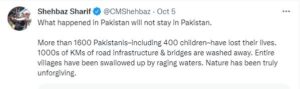
    “What happened in Pakistan will not stay in Pakistan,” Pakistan prime minister Shehbaz Sharif tweeted late Wednesday evening. Sharif was not speaking about terrorism. He was speaking of the looming climate-related disasters.

    Sharif warned that the looming climate change would not spare other countries after the flash floods inundated one-third of Pakistan and left millions homeless.

    “What happened in Pakistan will not stay in Pakistan,” his tweet read, as he reiterated his call for urgent action a day after the UN issued a revised flash appeal of US$ 816 million as relief assistance for the flood-stricken people of the country.
    - Advertisement -
    Pakistan climate change flood disaster humanitarian emergency Shehbaz Sharif
    ‘What happened in Pakistan will not stay in Pakistan’, PM Shehbaz Sharif Warns

    A month ago, an initial US$ 160 million flash appeal was made to address immediate needs based on estimates. However, the results of the recent needs assessments, that led to the up-scaling of the flash appeal to $816 million, revealed that much more was needed to save those struggling to survive the aftermath of the floods.

    Through his tweet, Sharif highlighted that more than 1,600 Pakistanis–including 400 children had lost their lives due to massive floods besides thousands of kilometres of road infrastructure and bridges washed away.

    “Entire villages have been swallowed up by raging waters. Nature has been truly unforgiving,” he said.

    Shehbaz Sharif had recently actively sought international help for the flood-hit country on international platforms, including at the Shanghai Cooperation Organization summit in Uzbekistan, in London, and at the 77th session of the United Nations General Assembly.

    In his meetings with over 50 world leaders on the eves of SCO and UNGA last month, the prime minister called for climate justice and appealed to the world to share the burden of the climate crisis. He also highlighted that Pakistan was responsible for less than one per cent of the world’s planet-warming gases and yet, it was the eighth most vulnerable nation to the climate crisis.
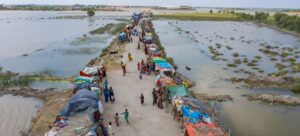
    Pakistan climate change floods disaster humanitarian emergency
    Pakistan is said to be responsible for less than one per cent of the world’s planet-warming gases and yet, it is the eighth most vulnerable nation to the climate crisis.

    During his participation at both the important global and regional forums, Sharif has interacted with foreign media to relay his message about the importance of an emergency action plan against climate change and seek funds for combatting the humanitarian emergency his country faces.

    - Advertisement -

    LEAVE A REPLY

    Please enter your comment!
    Please enter your name here

    Latest news

    Bangladesh’s Rape Response System on Brink as 373 Crisis Workers Go Unpaid for Nine Months

    The Ministry of Women and Children Affairs continues to insist that recruitment will be completed “shortly.” Until then, 373 unpaid workers remain the thin line between Bangladesh’s formal commitment to protect survivors of rape and the practical reality of a system under severe strain.

    Channels of Courage: How Sri Lanka’s Newest Literary Anthology Is Amplifying Fresh Voices

    Channels 2026 does not claim to define the nation’s writing. Instead, it opens another channel for stories that might otherwise remain private.

    Pakistan Records Sharpest Quarterly Rise in Violence Since 2021 as Fatalities Surge 83%

    The data underscore a central reality of contemporary South Asia: insecurity in one corner of the region rarely remains contained.

    ADB Approves $100 Million Loan to Overhaul Sri Lanka’s Vocational Training and Boost Women’s Jobs

    International experience shows that well-designed TVET systems can reduce youth unemployment, raise female labour force participation, and support economic diversification.
    - Advertisement -

    Global Food Prices Hit Near Four-Year High as Supply Disruptions Mount

    Analyses have flagged the potential for El Niño to push food inflation into double digits in import-dependent economies, compounding pressures on households still recovering from earlier crises.

    Nepal’s $50 Million Bid to Drain Four Glacial Lakes Falls Short, Scientists Warn

    Bhutan, India and the Tibetan plateau all host growing inventories of potentially dangerous lakes.

    Must read

    Bangladesh’s Rape Response System on Brink as 373 Crisis Workers Go Unpaid for Nine Months

    The Ministry of Women and Children Affairs continues to insist that recruitment will be completed “shortly.” Until then, 373 unpaid workers remain the thin line between Bangladesh’s formal commitment to protect survivors of rape and the practical reality of a system under severe strain.

    Channels of Courage: How Sri Lanka’s Newest Literary Anthology Is Amplifying Fresh Voices

    Channels 2026 does not claim to define the nation’s writing. Instead, it opens another channel for stories that might otherwise remain private.
    - Advertisement -

    More from the sectionRELATED
    Recommended to you