
All naturally occurring climate events now take place in the context of human-induced climate change, which is increasing global temperatures, exacerbating extreme weather and climate, and impacting seasonal rainfall and temperature patterns.
An update from the World Meteorological Organization late August says it is likely that the protracted La Niña event will last until at least the end of the year, becoming this century’s first “triple-dip“ La Niña, spanning three consecutive northern hemisphere winters (southern hemisphere summers).
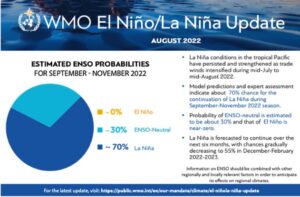
The WMO El Niño/La Niña Update predicts the continuation of the current La Niña over the next six months, with a 70 per cent chance in September-November 2022 but gradually decreasing to 55 per cent in December-February 2022/2023. It started in September 2020.
La Niña conditions in the tropical Pacific have strengthened as trade winds intensified during mid-July to mid-August 2022, affecting temperature and precipitation patterns and exacerbating drought and flooding in different parts of the world.
La Niña refers to the large-scale cooling of the ocean surface temperatures in the central and eastern equatorial Pacific Ocean, coupled with changes in the tropical atmospheric circulation, namely winds, pressure and rainfall. It usually has the opposite impacts on weather and climate as El Niño, which is the warm phase of the so-called El Niño Southern Oscillation (ENSO).
Drought; above average rain
However, all naturally occurring climate events now take place in the context of human-induced climate change, which is increasing global temperatures, exacerbating extreme weather and climate, and impacting seasonal rainfall and temperature patterns.
“It is exceptional to have three consecutive years with a la Niña event. Its cooling influence is temporarily slowing the rise in global temperatures – but it will not halt or reverse the long-term warming trend,” said WMO Secretary-General Prof. Petteri Taalas.
“The worsening drought in the Horn of Africa and southern South America bear the hallmarks of La Niña, as does the above average rainfall in South-East Asia and Australasia. The new La Niña Update unfortunately confirms regional climate projections that the devastating drought in the Horn of Africa will worsen and affect millions of people.”
“WMO will continue to provide tailored information to the humanitarian sector and to support sensitive sectors like agriculture, food security, health and disaster risk reduction. WMO is also striving towards the goal that everyone should have access to early warning systems in the next five years to protect them against hazards related to our weather, climate and water,” said Prof. Taalas.
Global Seasonal Climate outlook
El Niño and La Niña are major – but not the only – drivers of the Earth’s climate system.
In addition to the long-established ENSO Update, WMO now also issues regular Global Seasonal Climate Updates (GSCU), which incorporate influences of all other major climate drivers such as the North Atlantic Oscillation, the Arctic Oscillation and the Indian Ocean Dipole.
The ENSO and Global Seasonal Climate Updates are based on forecasts from WMO Global Producing Centres of Long-Range Forecasts and are available to support governments, the United Nations, decision-makers and stakeholders in climate sensitive sectors to mobilize preparations and protect lives and livelihoods.
Despite the stubborn La Niña in the equatorial central and eastern Pacific, widespread warmer than-average sea-surface temperatures elsewhere are predicted to dominate the forecast of air temperatures for September to November. This will contribute to above normal temperatures over land areas, including much of the Northern Hemisphere.
Precipitation predictions are similar to typical rainfall effects of La Niña, WMO says.
Image: License to use Creative Commons Zero – CC0