

Government, private sector, and farmer groups unite to strengthen climate-resilient, women-led goat value chains.
India’s goat economy took centre stage at the Herding Hope: National Goat Summit 2025, where over 100 stakeholders convened to co-create a roadmap for a smarter, inclusive, and climate-resilient goat value chain. The summit was hosted by Passing Gifts – A Subsidiary of Heifer International, with ICAR-Central Institute for Research on Goats (CIRG) and GIZ India as knowledge partners. The summit brought together leaders from government, private sector, development institutions, financial bodies, farmer producer organizations, and grassroots entrepreneurs.
India is home to over 148 million goats and 33 million rural households that depend on goat rearing for their livelihoods. Despite this scale, the sector continues to grapple with systemic challenges such as inadequate veterinary care, poor access to quality feed, low productivity, and limited market linkages.
Delivering the keynote address, Alka Upadhyaya, Secretary, Department of Animal Husbandry & Dairying, emphasized the vast yet underutilized potential of the goat sector in driving rural transformation. She called for a National Resource Organization to coordinate knowledge, partnerships, and breed improvement efforts. Citing the success of Black Bengal goat clusters in West Bengal, she advocated for a data-driven, cluster-based approach to enhance vaccination, artificial insemination, and market access. Benchmarking sectoral data, she noted, will spur private investment and enable more targeted, high-impact interventions.
In his address, Dr. Manish Kumar Chatli, Director of ICAR- Central Institute for Research on Goats (CIRG), unveiled the ‘Viksit Bharat Roadmap for the Goat Sector’—a visionary strategy aimed at boosting productivity, strengthening resilience, and advancing value chain integration through science-driven, climate-smart innovations.
GIZ India, through Indo-German development cooperation projects like ERADA and AVCERR, emphasised community centric approaches and convergence of rural development programmes to scale successful livelihood models across states and nationally. Goat, moringa, aquaculture, and mango value chains linking programmes like Mahatma Gandhi NREGA and NRLM among others are a few examples.
Innovative Approaches
Expert panels discussed innovative approaches to financing smallholder goat farmers, scaling veterinary and extension services to the last mile, and building resilient value chains through robust partnerships with farmer-producer organizations, the private sector, and traceability solutions. These conversations reinforced the need for convergence between public policy, private capital, and grassroots innovation.
Rina Soni, Executive Director Passing Gifts, a subsidiary of Heifer International reiterated the organization’s commitment to placing smallholder farmers—particularly women and youth—at the center of this transformation. “Our goal is to elevate goat-based livelihoods through integrated models that put women and smallholders at the centre of growth and policy,” she said.
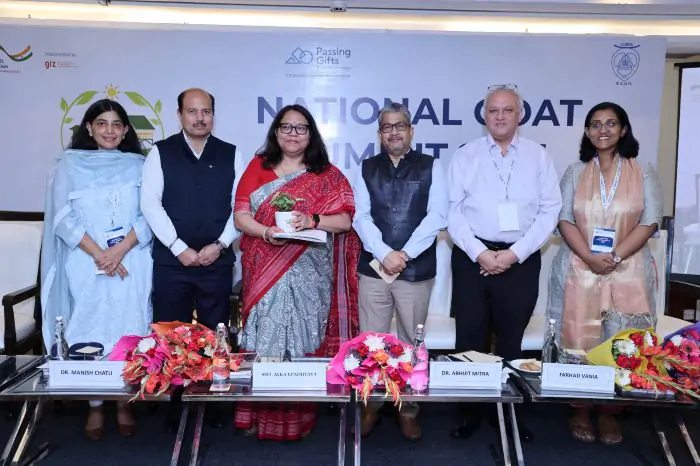
Meekha Hannah Paul, Senior Advisor at GIZ India, thanked Passing Gifts, ICAR-CIRG, and all partners for their collaborative efforts in the goat sector. She highlighted the Herding Hope: National Goat Conclave as a significant step in uniting stakeholders. Farhad Vania, Portfolio Management Advisor, GIZ India emphasized GIZ’s commitment to agroforestry, agriculture, and goat-related projects in India through Indo-German partnerships.
The summit drew participation from key industry stakeholders including Zappfresh, Licious, Chevon, NABARD, Indian Federation of Animal Health Companies (INFAH), ICAR-National Research Centre on Meat (NRCM), and the Gates Foundation, alongside experienced goat entrepreneurs and technical experts. The diverse attendance reflected a growing consensus on the importance of multi-sector engagement in building resilient livestock economies.
The event concluded with a strong call for a national framework that facilitates the convergence of policy, finance, innovation, and community-led action—laying the foundation for scalable, climate-smart, and women-led goat value chains. The framework should also promote Public-Private Partnership (PPP) models, leverage blended finance, and implement de-risking mechanisms to attract investments and ensure the sustainability and resilience of goat enterprises—paving the way for the transformation of rural India’s economic future.
