

The Multi Hazard Risk Assessment (MHRA) hackathon brought together experts, early career professionals, and students with a background in modelling to form interdisciplinary groups to MHRA case studies.
By Manish Shrestha, Bipin Dulal and Saswata Sanyal
With climate change accelerating, disasters are no longer isolated events across the globe. In the Hindu Kush Himalaya, increasingly complex and interconnected natural hazards are becoming more frequent. Events such as floods, landslides, glacial lake outburst floods (GLOFs), and cyclones – whether occurring independently or interacting – are causing massive loss and damage (Maharjan, et al., 2021). The impact of such events in the countries of the HKH is elevated due to its dense populations, fragile geography and rapid unplanned development (Tsering et al., 2021).
Addressing these challenges requires a shift from assessing single hazards to a comprehensive multi-hazard risk assessment (MHRA) approach. Multi-hazard risk assessment is a process of evaluating the impact of multiple natural hazards in a specific geographic area and time. By examining how different hazards interact and amplify one another, policymakers and communities can better prepare for future disasters. The International Centre for Integrated Mountain Development (ICIMOD) is at the forefront of these efforts, working to develop innovative disaster risk reduction (DRR) strategies that integrate MHRA into planning and policy frameworks across the region. By bringing together experts and policymakers, ICIMOD plays a critical role in ensuring that risk assessments translate into real-world policies that protect lives and livelihoods.
ICIMOD’s Efforts in Multi-hazard risk Management
As a regional intergovernmental hub, ICIMOD facilitates knowledge sharing and learning among its eight Regional Member Countries (RMCs) – Afghanistan, Bangladesh, Bhutan, China, India, Myanmar, Nepal, and Pakistan, aiming to influence policy and practices to address critical environmental and livelihood challenges.
A key component of ICIMOD’s 2030 strategy, and especially within our Action Area on cryosphere and water and our Intervention on DRR – is a strong emphasis on MHRA, which aims to understand how various hazards interact. This approach helps communities and policymakers in the HKH develop effective mitigation strategies in response to the growing frequency of such disasters.
One example from the HKH includes the cascading floods in Melamchi, Nepal in 2021, which were triggered by heavy rainfall, snow melt, a GLOF and ‘landslide damming’ – a permanent or ephemeral interruption of a river caused by landslide deposition. Other examples include the devastating floods in Sikkim, India in 2021, resulting from intense rainfall combined a GLOF; and the compound impacts of a dry winter followed by widespread forest fires in Nepal in 2024. Such extreme events underscore the critical need for integrated MHRAs in the HKH.
ICIMOD’s mid-term action plan for 2023–2026 emphasises the need for RMCs to integrate innovative DRR approaches into their policies and investments. To achieve this, ICIMOD has been advocating for the adoption of comprehensive MHRAs that consider cascading, compound, and amplifying impacts.
ICIMOD developed a MHRA framework in 2022–23. With the increasing impact of multi-hazard risks in the HKH, the team revised the draft framework to integrate how hazards interact with each other in the region through computer modelling. These modelling helps to analyse past disaster as well as future scenarios. The proposed framework also aims to assist stakeholders in implementing MHRAs, in order to enhance resilience and inform effective risk mitigation strategies.
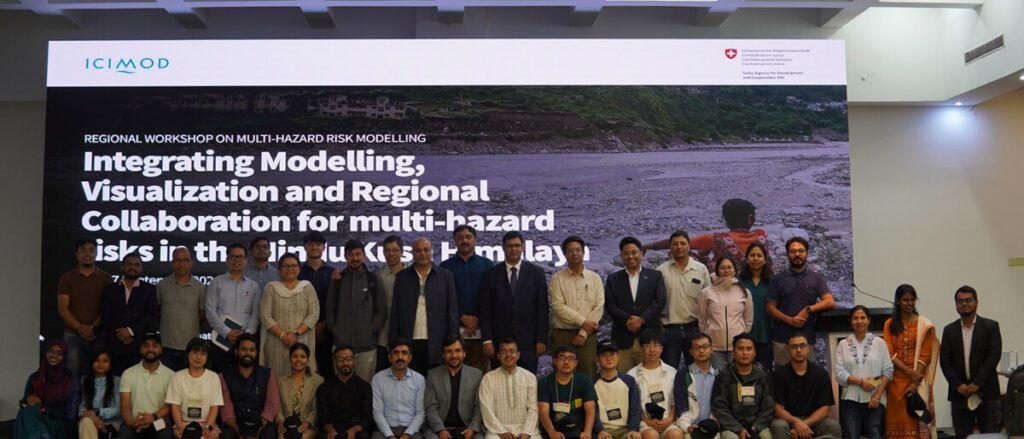
Multi-hazard Modelling Hackathon
As a part of its efforts to provide the RMCs with a regional framework for MHRA that addresses interaction between the hazards, ICIMOD’s DRR intervention team organised a five day ‘hackathon’ in September 2024 at Lalitpur, ICIMOD headquarter. A hackathon is an event, typically lasting a few days, where individuals or teams collaborate intensively to create ideas or innovative solutions, within a limited time frame.
The MHRA hackathon brought together experts, early career professionals, and students with a background in modelling to form interdisciplinary groups to MHRA case studies. These case studies are aimed to leverage computer models, remote sensing data, field research, and secondary data sources to test the HKH-MHRA framework. Six different teams were formed during the MHRA hackathon, each team focusing on specific hazard interactions such as cyclone, drought, forest fire, Glacier Lake Outburst Flood, and landslide.
As a part of the MHRA hackathon, participants and experts from these teams visited the Melamchi area in eastern Nepal, which had been hit by severe flooding in June 2021, to observe the cascading impacts of the disaster and to model different scenarios of hazard interaction in the different RMCs. Melamchi flood-affected area to. A report published by ICIMOD confirmed that heavy rainfall, snow melt, erosion of glacial deposit, glacial lake outburst, landslide and river damming, riverbank erosion and debris deposition triggered severe flooding in Melamchi river and caused damages to the nearby areas.
End game
The primary objective of the project is to develop a validated and replicable MHRA framework. Once established, this framework will be disseminated across the RMC counties. The project will then move toward actively engaging with the National Disaster Management Authorities of the HKH countries. ICIMOD intends to promote the integration of the MHRA framework into national policies by collaborating closely with these agencies to foster a proactive and coordinated approach to multi-hazard risk reduction. This effort will pave a path on creating methods for modelling multi-hazard interactions and advancing multi-hazard early warning systems.
