

United Nations Secretary-General António Guterres said at the United Nations General Assembly that a third of Pakistan had been deluged and that many island States face “the very real prospect of their entire homeland going under.”
United Nations Secretary-General António Guterres told the UN General Assembly on Friday that while Pakistan was responsible for less than one per cent of global greenhouse gas emissions, it is paying a “supersized price for man-made climate change”.
During a full session of the UN’s most representative body on the country’s devastating floods, he recalled last month’s visit where he saw “a level of climate carnage beyond imagination”.
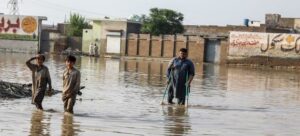
He described flood waters covering a landmass three times the total area of his own country, Portugal, saying that many lost their homes, livestock, crops and “their futures”.
“Lives were washed away”, he spelled out, calling upon the world community to act.
Noting that a third of Pakistan had been deluged, Mr. Guterres said that many island States face “the very real prospect of their entire homeland going under”.
“Communities everywhere are looking down the barrel of climate-driven destruction,” he said. “We must act – and we must act now”.
While this time it was Pakistan, the Secretary-General warned that tomorrow, “it could be any of our countries and our communities”.
“Climate chaos is knocking on everyone’s door, right now,” he concluded. “This global crisis demands global solidarity and a global response”.
The Assembly President, Csaba Kőrösi, highlighted the need to be better prepared as droughts and rains return.
More than ever, international relief efforts must focus on transformative solutions, he said. “Adaptation and resilience are the seeds of sustainability”.
Kőrösi urged the ambassadors to “make use of science and solidarity…to enhance our crisis management capacities…[to] rebuild together”.
Cascading calamities
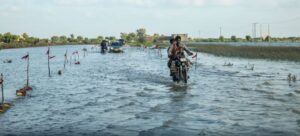
While the rains have ceased and water is beginning to recede, many areas in the south remain inundated and, with winter approaching, the situation is going from bad to worse.
“Pakistan is on the verge of a public health disaster”, warned Guterres, pointing to threats of cholera, malaria and dengue fever claiming “far more lives than the floods”.
He painted a picture of nearly 1,500 devastated health facilities, two million damaged or destroyed homes and more than two million families without their possessions. “Many have no shelter as winter approaches,” he said.
At the same time, the scale of crop and livestock destruction is “creating a food crisis today and putting the planting season in jeopardy tomorrow”, Guterres continued.
“Severe hunger is spiking. Malnutrition among children and pregnant lactating women is rising. The number of children out of school is growing. Heartache and hardship – especially for women and girls – is mounting,” he elaborated.
Moreover, more than 15 million people could be pushed into poverty.
The effects of the floods will be felt not just for days or months but will linger in Pakistan for years to come.
Massive support needed
Working with the Pakistan Government to convene a pledging conference to provide rehabilitation and reconstruction support, the UN chief urged donor countries, international organizations, the private sector and civil society to fully support these efforts.
Meanwhile, the Organization launched the Pakistan Floods Response Plan calling for $816 million – a surge of $656 million from the initial appeal – to respond to the most urgent needs through next May.
“But this pales in comparison to what is needed on every front – including food, water, sanitation…and health support”, said the Secretary-General.
As the calendar moves quickly to next UN climate conference (COP27) in November, he said “the world is moving backwards [as] greenhouse gas emissions are rising along with climate calamities”.
Do also read: ‘What happened in Pakistan will not stay in Pakistan’
The UN chief stressed that COP 27 must be the place where these trends are reversed, serious action on loss and damage taken, and vital funding found for adaptation and resilience.
Reminding that the G20 leading industrialized nations drive 80 per cent of climate-destroying emissions, he called it their “moral responsibility” to help Pakistan recover, adapt and build resilience to disasters “supercharged by the climate crisis”.
