

Digitalization of rural communities is leading the way to a better future across Asia and the Pacific. But, it must be remembered that the goal is to leave no one behind.
By Jong-Jin Kim
It wasn’t that long ago that Internet connectivity faded the moment one left a populated area like a city or big town – “no service” was the take-away message back then. But thanks to 3G, 4G and now 5G mobile technology, coupled with widespread installation of cellular towers in rural areas region-wide, that little message shows up much less frequently.
Most importantly, the rapid spread of internet connectivity and mobile telephony, reaching into the most remote rural communities, has resulted in countless opportunities to help address chronic problems such as poverty, malnutrition and inequality.
From farmers to fishers to herders, digital technologies are increasingly relied upon to help transform and enhance livelihoods for hundreds of millions of people each day. From a smart phone in the hands of a woman or man checking optimal conditions to sow a field, or band together to rent a drone for aerial assessments, to a herder checking the weather, to fishers finding the best places to cast their nets, digital technologies are becoming increasingly accessible, useful and affordable for those in rural areas.
This paradigm shift offers great hope to get this region – and the world – back on track to meet the 2030 SDG deadline.
Pressing need for digitalisation
While this digital revolution sweeping rural areas of Asia and the Pacific holds great promise, not everyone is benefiting equally. Indeed, in some cases, digital technologies can even be disruptive, or lead to unintended consequences by widening, not reducing, the digital divide if their implementations result in a loss of decent work.
This needs to be addressed, and it’s in everyone’s best interests to do so. Policy makers in countries across the region do understand the added value, and they see the economic benefits digitalization of rural areas bring to their nations and people. Hence, investing in an enabling environment to ensure equal access is key to ensuring the benefits of rural digitalization are enjoyed more broadly.
Digitalization of rural areas is needed now – more than ever before
Indeed, the move to accelerate implementation of digital technologies, equitably across the region’s rural areas couldn’t come at a more important time. The global pandemic hit rural communities disproportionately hard – particularly with respect to individual livelihoods. Now, as we try to recover from the devastation of COVID-19, we are facing the highest prices for many basic foods – the highest we’ve seen in decades. Higher food costs hit poorer and marginalized communities the hardest, particularly in rural areas, as they must spend a greater proportion of their disposable income to feed their families.
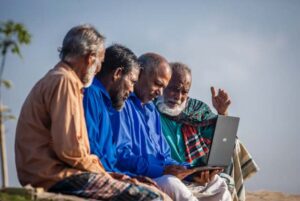
An inclusive digital village
These challenges are compounding an already existing and alarming situation. Last year, prior to the inflation of food commodities, FAO and partners pointed out that many people – at that time – already couldn’t afford a healthy diet in Asia and the Pacific.
By leveraging the advancements offered by digital technologies we can find ways to counter some of these and other devastating negative effects that already existed such as severe weather related events, droughts and floods.
That is already happening in some countries in this region, and they are well on the road to digitalization of even the smallest and most remote villages and towns. And they have good examples to share with their neighbours.
At the Food and Agriculture Organization of the United Nations (FAO), we’ve been following these trends, policies and initiatives of our Member Nations in the Asia-Pacific region. We know the full scale of their desire and determination to embrace, and fully harness, the potential of digitalization.
For our part, FAO has pledged to assist in bringing together these existing good practices of our Members, and to create a space for others to share their digital solutions as part of FAO’s 1,000 Digital Village Initiative. A key component of this initiative is the Digital Village Knowledge Sharing Platform for Asia-Pacific that can act as a one-stop village square, where those working in the food and agriculture sectors can share their innovations and technologies with us all.
A digital village isn’t necessarily a small place. It is a concept – one that is inclusive, operational, country-led and fit-for-purpose to deliver solid benefits to people.
At the end of the day, the ultimate goal is to make things better for everyone.
Working together, and sharing together, this region’s digital village innovations and technologies can help lead us all to a world of better production, better nutrition, better environment and a better life – leaving no one behind!
Jong-Jin Kim is Assistant Director-General and Regional Representative, Food and Agriculture Organization of the United Nations (FAO).
This piece has been sourced from Inter Press Service
Images: FAO
