More

    ‘Brutal’ Discrimination Adds Trauma to Roma as they Flee War-torn Ukraine

    Among the 2 million refugees who have fled Ukraine were Roma refugees who say they were discriminated against as they tried to escape. Their Indian origins have been a reason for the stigma they face.

    By Ed Holt / Inter Press Service

    Roma refugees fleeing war-torn Ukraine are facing discrimination on both sides of the country’s borders at the end of often harrowing journeys across the country, rights groups have claimed.

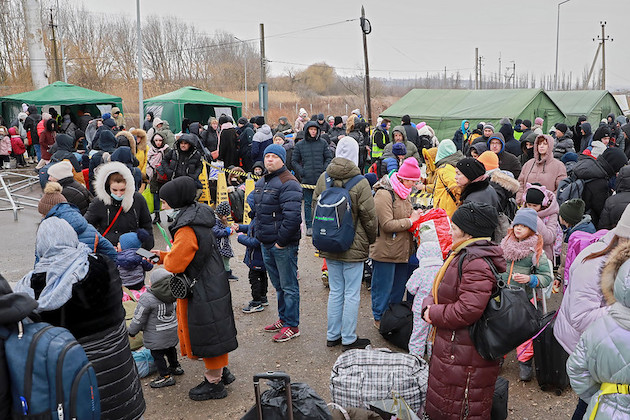
    Russia’s invasion of Ukraine on February 24 has sparked what the UN has described as the fastest-growing refugee crisis in Europe since WWII, and as of March 9, an estimated 2 million people had left the country.

    These include Roma who, like other refugees, abandoned their homes and communities as fighting broke out across the country.

    But having reached borders of neighbouring states, they have found themselves subject to what some groups helping them have described as “brutal” discrimination.

    “Groups working on the ground at borders in Slovakia, Romania, and Hungary have confirmed discrimination to us, and also media reports have backed this up. Roma are facing discrimination both by border guards, and then local people once they get out of Ukraine. It’s very sad and disappointing, but not surprising,” Zeljko Jovanovic, Director of the Roma Initiatives Office at the Open Society Foundation (OSF) told IPS.

    Roma living in Europe are among the most discriminated and disadvantaged groups on the continent. In many countries, including Ukraine where it is thought there are as many as 400,000 Roma, significant numbers live in segregated settlements where living conditions are often poor and extreme poverty widespread.

    Health in many such places is also bad with research showing very high burdens of both infectious and non-communicable diseases and significantly shorter lifespans than the general population.

    Discrimination

    Incidents of discrimination of Roma have been reported at the borders of all countries that are taking in refugees, according to the OSF and the European Roma Rights Centre (ERRC).

    These have included being made to wait much longer in lines, sometimes tens of kilometres long, in freezing weather, than ethnic Ukrainian refugees, before they are processed.

    “They are always the last people to be let out of the country,” said Jovanovic.

    Media reports have quoted refugees describing discrimination and, in some cases, physical attacks.

    One Roma woman who had made her way to Moldova said she and her family had spent four days waiting at the border with no food and water, and having found shelter were then chased out of it by Ukrainian guards.

    Groups working with the refugees said Roma who crossed into their countries told them similar stories.

    Viktor Teru of the Roma Education Fund in Slovakia said: “Roma refugees tell us that on the Ukrainian side there is ‘brutal’ discrimination.”

    But once they finally make it over the border, their problems often do not end there.

    Bela Racz, of the 1Hungary organisation, which is helping Roma refugees in Hungary, said he had witnessed discrimination during three days his organisation spent in the eastern Hungarian border town of Zahony at the beginning of March.

    “Roma arrived in separate coaches – the Ukrainian border guards organized it this way – and when they did arrive, Roma mothers were checked by Hungarian police many times, but non-Roma mothers were not.

    “Local mayors and Hungarians are not providing direct help, such as accommodation, and information, [for Roma] in their towns – that only comes if we ask for it and organise it. Roma did not get proper help, information, or support,” he told IPS.

    More media reports

    There have been numerous media reports of similar discrimination at border crossings in other countries, including incidents of Roma being refused transport by volunteers, and being refused accommodation.

    Jaroslav Miko, founder of the Cesi Pomahaji (Czechs Help) NGO, who has transported more than 100 Roma refugees from the Slovak-Ukrainian border to the Czech Republic, told IPS he had seen “discrimination of Roma among the volunteers who were picking people up at the border”. He said volunteers were picking up some refugees in vehicles and taking them to other places, but that Roma families were being turned away if they asked for help.

    In another incident, the head of a firefighting station in Humenne, in eastern Slovakia, where many Roma refugees have been sent to a holding camp, told a reporter that the refugees had “abused the situation”. “They are not people who are directly threatened by the war. They are people from near the border, they have abused the opportunity for us to cook them hot food here and to receive humanitarian aid,” the firefighter allegedly said, adding that Ukrainian Roma should not be allowed across the border.

    Slovakia’s Interior Minister Roman Mikulec and national fire brigade officials have refused to comment on the claims.

    Indian connection

    But despite these incidents of discrimination, Roma refugees are getting local help – from other Roma.

    “Many Hungarian Roma living in nearby villages are providing accommodation for Roma. Due to the presence of groups like ours, and state representatives, the situation with discrimination is getting better,” said Racz.

    “There is a good network of Roma activist groups coordinating work to help refugees and also there are Roma mayors in many towns near the borders in Romania and Slovakia who are prepared to take Roma refugees and arrange shelter for them,” added Jovanovic.

    However, all those who spoke to IPS said the discrimination against Roma refugees was a reminder of the systemic prejudice the minority faces.

    Meanwhile, Jovanovic said he hoped that the problems Roma refugees were facing now would not be forgotten, as they had been in the past.

    Europeans see Roma as Gypsies. They are believed to have arrived in Europe from India’s northern province of Punjab as a nomadic people between the eighth and tenth centuries C.E.  This minority is made up of distinct groups called “tribes” or “nations.”

    Roma cultural heritage includes a rich oral tradition, art forms such as flamenco, an emphasis on family, and Romanës, the Roma language.


    This piece has been sourced from Inter Press Service

    Image: UN Women
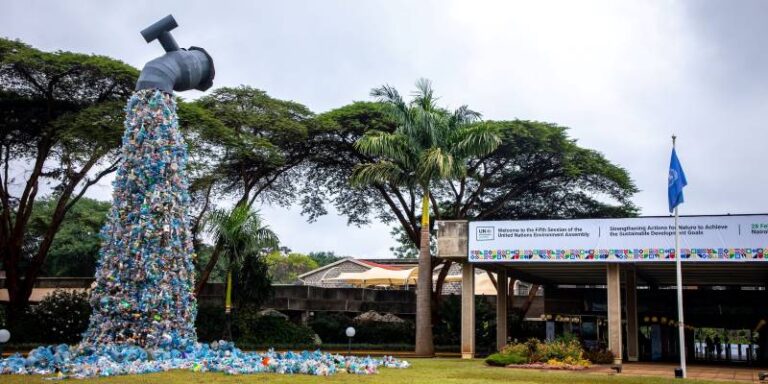
    World’s nations commit to ending plastic waste

    The UN’s draft resolution on ending plastic pollution has been described as the most important international environmental deal since the Paris Agreement.

    By Emma Bryce

    The United Nations has laid the foundation for negotiations to begin on the world’s first legally binding treaty to end plastic pollution. At the United Nations Environment Assembly (UNEA) in Nairobi earlier this month, the parameters were set for a future treaty, including hard-won provisions to address the full life cycle of plastics and tackle waste in all environments, not just the ocean.

    The decision on 2 March was met with applause, cheers and tears as delegates from 175 member states gathered to negotiate several multilateral environmental agreements, but most notably one on plastics.

    “The bottom line is, we will eliminate plastic pollution from our environment,” said Inger Andersen, executive director of the United Nations Environment Programme (UNEP), during the closing plenary.

    “It’s a really important step. When I first started working on [plastics], there wasn’t a broad consensus about the scale of the problem, or even agreement that there was a problem,” says Richard Thompson, a marine scientist at the University of Plymouth who has been studying plastic pollution for 30 years, and coined the term “microplastics”.

    With plastic production doubling from 234 to 460 million tonnes in the past 20 years, it is now accepted that the scale of the resulting pollution means that neither voluntary nor national actions are enough. In recent years there has been a push for a coordinated global response, backed by a Scientists’ Declaration and popular opinion. A survey published last month by WWF revealed that nine out of 10 citizens in 28 countries believe in the need for a global treaty on plastic waste, with the greatest support coming from Mexico, Peru and China. Even plastics producers and brands heavily dependent on plastic packaging, such as Coca-Cola, Nestlé and Unilever, are backing the idea.

    Ambitious, urgent and wide-ranging

    This mounting support came to a head during a week of negotiations in late February, when countries used two proposals for tackling plastic pollution put forward by Rwanda and Peru and by Japan as the basis for a final resolution. After days of heated discussion and fine-tuning, a draft was tabled for consideration by the world’s environment ministers in the early hours of 28 February, the day the UNEA began.

    The adopted text has been called the “most important” deal since Paris. It insists that a final treaty be legally binding, which was not a guarantee at the start of negotiations. The text, which  calls for an “end”, rather than a reduction, to plastic pollution, sets an ambitious 2024 deadline for finalising the treaty.

    “Countries have come together and said, ‘We want to do this quickly in recognition of the urgency of the problems’,” says Christina Dixon, deputy campaigns lead for oceans at NGO the Environmental Investigation Agency (EIA), who was an observer during the negotiations.

    Civil society groups are celebrating the ambitious scope of the resolution, which reduces the risk of negotiators delivering a narrow and toothless treaty. The text asserts that negotiations must focus on ending all plastic pollution in all ecosystems, not just marine environments (where most policy efforts are currently focussed due to the large-scale impacts there). This provision is important given river-transported plastic is a major source of ocean pollution, particularly in Asia.

    Turn off the tap

    The resolution also uses a generous interpretation of “impact”. Rather than just plastic waste, it considers the well-established risks that chemicals from plastics pose to human health, with microplastics now found in major organs including human placentas.

    Crucially, it specifies that a future treaty must address the full life cycle of plastic if it is to succeed. This widens the scope beyond tackling waste to potentially reducing production, especially of single-use products.

    “The industry is always saying, ‘We need a better mop.’ But in reality, we need to turn off the tap,” says Christopher Chin, an expert on single-use plastic legislation and executive director of the non-profit Centre of Oceanic Awareness, Research and Education, which was also an observer at the talks. The resolution responds to that need by “looking at plastic pollution in a more holistic way”, he says.

    The resolution includes provisions for financing, Dixon notes, which will help countries meet their legal obligations once a treaty comes into force. That’s important because, as the text highlights, establishing new circular economies will be key to limiting plastic production, increasing recycling and extending its life: these upgrades will require significant resources in countries that don’t have the capacity yet.

    The resolution calls for national action plans and better plastic production and waste monitoring, crucial to measure progress. It also highlights the role of indigenous and traditional knowledge in forming solutions, and recognises the role of informal waste-pickers in recycling plastic globally.

    “Broadly speaking, we’re pretty happy with the contents of the resolution,” says Dixon. “There’s a reference to health, which means that we can have a conversation about [toxins from plastics],” she says. “It talks about sustainable production and consumption, which means we can talk about reporting on plastic production.”

    From resolution to treaty

    The resolution establishes an intergovernmental negotiating committee, which will thrash out the terms of the final treaty. Its first meeting is scheduled for May 2022 in Senegal.

    Some of the tougher debates will centre around how the treaty enables all countries to enact the necessary changes to their plastic economy – such as establishing circular infrastructure. Colombian lawyer Mónica de Greiff Lindo, speaking at the UNEA on behalf of the G77 and China, emphasised that developing countries will need finance and technology transfer from developed countries to transition to sustainable systems of consumption and production. Firming up countries’ obligations for this will be crucial, she said.

    Another challenge is creating supportive markets for plastic alternatives and recycled materials. “We see the treaty as an enabler of progress,” said Ed Shepherd, senior global sustainability manager at the consumer goods giant, Unilever, speaking at a UNEA side event. But he added that the low price of virgin plastics may discourage businesses from getting their new products ready for the circular economy. One way for the treaty to correct skewed market dynamics would be to introduce extended producer responsibility schemes that build the costs of plastic waste into production, or to apply a tax on virgin plastics.

    Christopher Chin cautions that open-ended wording in the resolution text around the “full life cycle” of plastics could lead to questions about where exactly a plastic’s “life” begins, and therefore who has responsibility to tackle production and waste. “Some people will tell you that the lifecycle of plastic begins as a product, or as a polymer, or at extraction,” he explains. On this point, Dixon says the EIA will be watching for lobbying during the negotiations, because the new life cycle focus might bring fossil fuel companies into the picture: “The petrochemical industry hasn’t really had to worry about this until the deal was done,” she says.

    Search for solutions

    Richard Thompson says that in the inevitable scramble for solutions that this global agreement will trigger, more research is needed to determine what really works. “We’ve got more evidence than we need about [plastics’] harm. What we don’t have as much evidence about is how to apply which solution in which context, in order to get the best traction,” he says.

    This will require environmental scientists, economists, materials scientists, behavioural psychologists, and others to come together to find holistic solutions along the entire plastics life cycle, he says. Without this, a treaty runs the risk of enforcing measures that are ill-fitted to the challenge.

    In the meantime, UNEP executive director Inger Andersen urged countries to take the momentum of the talks back home. She used Kenya, the home of the UNEA, as an example of a country that has recently brought in decisive bans on single-use plastics. “Do not sit back and wait for the plastic treaty to be ratified and signed,” she said. “There is lots that you can do.”


    Image: UNEP

    This piece has been sourced from The Third Pole

    A Rude Awakening for America and its Allies

    America’s strength lies where it always has—in freedom, equality, human rights, and above all, in genuine patriotism and unity, as the nation must always come first before any political party or individual’s interests. Putin has challenged the West and we all came together.

    By Alon Ben-Meir

    Russia’s invasion of Ukraine was certainly not a surprise and has unambiguously exposed the West’s weakness. The question is what lesson the United States and its allies should learn from it and what measures they must now undertake to prevent Putin or any future ruthless Russian autocrat from ever daring to invade another country.

    Righting the Wrong

    As we observe the horrifying unfolding events in Ukraine, the escalating death toll, and the destruction that is raining down on cities and innocent Ukrainians, we must be true to ourselves and admit that we—the US and our European allies made it possible for Putin to wage such an unprovoked and unjustified war.

    Since the collapse of the Soviet Union in 1991, we have basically taken for granted the new world order, believing that the Soviet Union is a thing of the past and that Putin’s ambition to resurrect the Russian Empire is nothing more than posturing. We have dealt with his military campaigns in Georgia and his annexation of Crimea by imposing sanctions, which have hardly been crippling.

    Meanwhile, we have steadily been exposing our vulnerabilities, which Putin has been carefully and diligently studying, preparing himself for what we are now witnessing with great alarm but great moral failing.

    To understand the magnitude of Putin’s danger to the world order, it suffices to quote US Ambassador to the UN, Linda Thomas-Greenfield, who stated that “Putin asserted that Russia today has a rightful claim to all territories – all territories – from the Russian Empire; the same Russian Empire from before the Soviet Union, from over 100 years ago, ” including Ukraine, Finland, Belarus, Georgia, Moldova, Kazakhstan, Kyrgyzstan, Tajikistan, Turkmenistan, Uzbekistan, Lithuania, Latvia, Estonia, and parts of Poland and Turkey”.

    The State Department later declared “These countries are sovereign. They are independent. They are not part of Russia. You [Putin] have no claim to them,” which suggests how dangerous and out of control Putin is. In response to this unparalleled state of affairs, the West under American leadership must regroup and commit to spare no effort to stop Putin in his tracks and be prepared to take whatever measures are necessary to that end.

    There are five areas that we have sorely neglected and allowed to fester, which we must now tackle with utmost urgency if we want to prevent another catastrophe and restore stability and peace in the European theater.

    Provide military aid to non-NATO member states

    Although the Biden administration knew for several months, based on solid intelligence, that Putin was planning to invade Ukraine and shared that information with our allies, they did not provide the Ukrainian army with defensive and offensive weapons ahead of time.

    What is worse is that weeks before the invasion, Biden publicly stated that the US had no intention of interfering militarily on behalf of Ukraine, which sent exactly the wrong message to Putin—that he should not fear NATO intervention.

    Moreover, NATO member states waited for the invasion to happen before they decided to rush such equipment, which would have otherwise sent a clear message to Putin that the West stands firmly behind Ukraine.

    Contrary to NATO member states who enjoy collective security, many non-NATO democracies, including Finland, Sweden, Georgia, Bosnia and Herzegovina, and Ukraine itself, do not have the same security protection and hence NATO could not interfere militarily to stop the invading Russian forces.

    Moreover, these states do not have the ‘security guarantees’ that the US provides to countries such as Israel, South Korea, Japan, albeit the US has some form of defense pact with 69 countries, mostly through NATO and the Organization of American States (OAS).

    The time is now for the US and its allies to provide significant military aid to these countries and not wait for the next Russian invasion. In addition, NATO should fast track the applications of the states that wish to join NATO. Strengthening their militaries and preparedness will force Putin or any other Russian despot to think twice before they dare to invade any of these countries.

    Doubling NATO members’ military appropriations 

    As European NATO members bicker about their military expenditure, which is required to be two percent of each member’s GDP, they continue to rely heavily on the US to carry much of the financial burden for their security. Meanwhile, Putin was busy building one of the most formidable military machines in modern times, which he put on full display as he invaded Ukraine.

    It is time wake up. NATO members must, at a minimum, double their military contribution from two to four percent to ensure that along with the US, NATO’s conventional military defenses and offensive capabilities are overwhelming to a degree that no Russian leader can ever presume to challenge with impunity.

    Moreover, it is in NATO’s best geostrategic interests to include other European countries, especially, Georgia, Bosnia and Herzegovina, and Kosovo, who have long wanted to join NATO.

    Mending relations with China

    As the US argued contentiously with China about its trade practices, Taiwan, and its human right abuses, Putin was investing much time and energy in developing close ties with China’s leader Chairman Xi, while expanding trade and military cooperation between their two countries.

    Both leaders want to limit America’s sphere of influence in Europe and Asia, and although they declared, when they met during the Winter Olympics, that there are “no limits” to the growth of their bilateral relations, the US can and should create daylight between them.

    The Biden administration must now carefully recalibrate its China policy. Notwithstanding their deep conflicting issues, it is time to mend relations with China. This is necessary not only because it serves America’s interest, but also will let the Chinese realize that there is a limit to Chinese-Russian bilateral relations and that the US remains an indispensable trading partner.

    China’s trade interest with the US is critical to its economy, in addition to the fact that more than $1 trillion of China’s reserve funds are held in US Treasury securities, not Russian banks.

    Moreover, both the US and China concur when it comes to respecting the sovereignty and independence of other countries (albeit the Chinese are much stricter in their philosophy of non-interference), and although China did not condemn publicly Russia’s invasion, it certainly expressed its displeasure with Moscow.

    The Biden administration should initiate new and comprehensive discussions with the Chinese government about all their differences and follow Kissinger’s negotiating approach to China by delinking the disputes over their conflicting issues.

    Regardless of how egregious China’s human rights violations are, the US should raise critical issues in private as long as it achieves the same objective. China resists any country that interferes in its domestic affairs and does not want to air its dirty laundry in public once they agree to engage in such discussions. However, if private pressure does not work, especially in ending China’s egregious violations, including genocide, public pressure can be resumed.

    Push for reforming the UNSC

    Although the United Nations Security Council (UNSC) was established to maintain global peace and security, it has long since lost its relevance. The veto powers accorded to the five permanent members—the US, UK, China, France, and Russia—have been frequently used by one or the other to serve their interest, regardless of how inconsistent that might have been to the goal of maintaining peace and security.

    During the UNSC emergency session as Russia was invading Ukraine, the Russian ambassador had the audacity to make a totally baseless and false statement declaring that Russia was merely sending peacekeeping troops to the eastern part of the country to prevent a “genocide” by the Ukrainian military against the people of Donetsk and Luhansk.

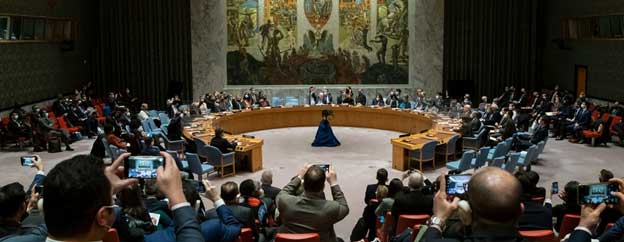
    During the session, we heard extraordinarily powerful and moving speeches, especially by the Ambassador of Ireland, but that was just about the extent to which the UNSC could go, which sadly and tragically has become nothing more than a debating forum. In fact, there is no more glaring example of how irrelevant the UNSC has become, than that debate on February 24.

    There is a dire need now to reform the UNSC to reflect the changing geostrategic and demographic reality and its impact on the global order. These reforms are critical to ensure that the UNSC lives up to its founding premise to maintain global peace and security.

    They must include enforceable political and sanctioning mechanisms to prevent a brazen and unprovoked invasion by Russia or any other power on a sovereign nation in the future. How absurd can it get when Russia, which invaded the sovereign democratic nation of Ukraine and committed war crimes, can still exercise its veto power against any resolution that condemns it, and do so without any repercussions?

    Although comprehensive reforms of the UN will be extraordinary difficult and may take years, the effort must nevertheless begin immediately and the focus should be on reforming the UNSC first to prevent a single country, and for that matter, one ruthless despot, from changing the world order.

    Despite overwhelming opposition from both the Security Council member states and the General Assembly, Putin went ahead with his planned invasion of Ukraine, knowing full well that he can grossly violate the UN Charter and do so with impunity.

    Strengthening American democracy

    While we were becoming accustomed to Putin’s outrageous behavior, America’s democracy was put on the chopping block thanks to Trump and his blind Republican followers. Trump spared no effort to polarize the country to the core while serving as Putin’s agent in the White House to trample on American democratic institutions. Our democracy became vulnerable and is retreating, which is precisely what Putin was hoping for and was ready to exploit—and he did.

    There is no better time than now for the Biden administration to strengthen our democratic institutions at home while making every effort to reach out to any Republican with an ounce of integrity to begin the healing process. Tragically, there are too many so-called Republicans who follow Trump and are ready to sacrifice America’s democracy on the altar of his twisted ego.

    Trump followers, to be sure, are sycophantic, a poison for our Republic, and the kiss of death to our democratic institutions. Every single one of them must look at themself in the mirror and ask: What do I stand for? Do I stand for unity and for our 240-year-old democracy and for what is right and moral, or do I stand for autocracy led by a moron like Trump who considers a vicious and dishonest thug like Putin, who is committing war crimes in broad daylight, a “genius”?

    America’s strength lies where it always has—in freedom, equality, human rights, and above all, in genuine patriotism and unity, as the nation must always come first before any political party or individual’s interests. Putin has challenged the West and we all came together.

    We must now build on this momentum and send the most unambiguous message to Putin—you have made a horrific mistake by invading Ukraine and you will pay for it. And we will ensure that your war crimes against the Ukrainian people will be the beginning of the end of your era and your reign of terror.

    I salute the courage of the Ukrainian people, I salute President Zelensky for his exemplary leadership, fortitude, and high moral standing, and I mourn for the Ukrainians who fought and died with valor and bravery for their country and for their freedom.


    Dr. Alon Ben-Meir is a retired professor of international relations at the Center for Global Affairs at New York University (NYU). He taught courses on international negotiation and Middle Eastern studies for over 20 years.

    This piece has been sourced from Inter Press Service

    Counting India’s wolves, one howl at a time

    India’s unique wolf population and the grasslands on which they live are under increasing pressure due to compensatory plantations and development schemes. Counting the wolves could aid conservation efforts. Identifying individual wolves by their howls is being studied as a potential technique for counting wolf population.

    By Siddhant Pusdekar

    “Some have a broken leg, some a broken tail.” That’s how Mihir Godbole says he identifies wolves in Saswad, just 31 kms away from the bustling city of Pune. A filmmaker and conservationist, he is founder of the The Grassland Trust and has been working with wolves in the outskirts of Pune for over a decade. In this time he has deeply studied the wolves and says he can identify 62 individuals by their unique characteristics.

    As for identifying the rest of the unknown number of wolves roaming the grasslands it can, according to Sougata Sadhukhan, be “very tricky to do so by their coats alone.” Wolves can also be identified by their howls, according to Sadhukhan, who is a PhD student at the Wildlife Institute of India (WII) and co-authored a study last year on the potential of identifying Indian wolves by their howls as a non-invasive survey method.

    When Godbole first began looking for wolves, it was hard to spot them. They would turn up at seemingly random spots. This made it hard to document and study them. Pastoral communities in the area have long since learned how to maintain a peaceful if tenuous relationship with these wolves. Looking to them for pointers, Godbole began documenting the biodiversity of the grasslands, especially the wolves.

    Competing with leopards, stray dogs

    But these grasslands, according to ecologist Abi Vanak, who has mapped India’s open natural ecosystems, are “the most undervalued ecosystems in India”. They are also under increasing pressure “due to the mad rush to plant trees in every available surface of land as a form of compensation for deforestation elsewhere”. He says this encourages, “species that require more cover, such as leopards, to colonise new areas, and potentially outcompete and displace the native species such as wolves.”

    And it’s not just leopards, stray dogs pose an even greater threat to Indian wolves. Because they are so closely related, they can transmit diseases and mate with each other. This “can wipe out entire packs”, Vanak says, leading to grave “long-term consequences for the unique Indian wolf.” All these intersecting threats make it crucial to document the threatened population of India’s wolves.

    The Indian grey wolf (Canis lupus pallipes) is protected under India’s Wildlife Protection Act (1972) but commonly found outside protected areas. Scientists are working on ways to identify individuals in the population, with acoustic-based monitoring being one such emerging technique. If successful, the scientists could conduct a census of India’s grey wolf population, making a case for its conservation and better understanding the species’ movement and behaviour.

    lone wolf, Indian grasslands

    Recognising the howls

    Sadhukhan began studying the wolves with a slightly different goal. He would look for den sites and scat. “The main objective,” he said, “was to track how wolves disperse in human dominated landscapes.” As part of this project, Sadhukhan also collected recordings of wolves. It was when he presented these recordings at a WII seminar back in 2016 that he realised these could be used to identify individuals. “But at that time the data was not very good,” he said. So he turned to people on the ground with knowledge about the locations of wolves. With help from The Grassland Trust and forest guards, he set about studying wolf sounds in Maharashtra.

    Among the many other sounds wolves make such as social squeaking, whining, whimpering, growling, the howl is the most suitable for identification. Wolves themselves use this as a marker, Sadhukhan explained, “They use howls to defend their territories and to locate individuals.”

    Vanak’s interests, meanwhile, is the movement of carnivores in grasslands. He says, “Howl or call-back surveys are a widely used non-invasive sampling tool, and can be quite useful to understand the number of packs in an area. Often you can tell how many animals are calling as well, although it does not tell you anything about the total pack size (since some members may not participate in the call or they may not be distinguishable).”

    But this becomes complicated when individuals move away from a pack or disperse, which Godbole mentioned happens every year.

    Howl about a database

    Sadhukhan’s goal of identifying individuals through their howls could be useful not just for identifying these individuals, but also to track how they disperse. Howls can be heard at a fairly long distance making it easy to record them for further analysis. “Whenever we play another wolf’s call, the wolf whose territory it is, will respond,” he said. Having recorded howls from known individuals he trained a model on these recordings. “This is supervised clustering,” he explained, “Our perception is used to train the model. Based on the data, our model was 98% accurate.”  This means if another howl was recorded from a known individual, the model did a pretty good job of identifying which wolf the howl came from. But could it identify an unknown individual? To see whether the model could successfully distinguish howls of a wolf it had never seen before, they fed it howls from a different set of wolves. This time, “we didn’t tell the model which howl was from which individual. This was 75 per cent accurate.” Sadhukhan said. So the model would correctly identify three out four new wolves it encountered. That’s not good enough for population estimates, but it may be better than existing alternatives.

    In human dominated landscapes, camera traps can be stolen, but perhaps the more pressing problem is the wolf’s natural tendency to avoid human things. Even if some wolves got accidentally photographed, it can be “very tricky to identify them with their coat patterns,” Sadhukhan explained. Capturing and tagging individuals is also much harder than recording howls from a distance.

    Besides, the howl identification model can be improved massively by collecting more data. While Sadhukhan did not have this during his research, he says, “With improving technologies it can be very easy to collect more data. Acoustic tags on collared wolves can record 24×7.” With more data, he says it is possible to have an estimate of the wolf population within 5-10 years.

    Wolves, India grasslands

    Conserving grasslands and wolves

    Meanwhile, just as Vanak warned, the plantations are inviting encroachers.

    “Leopards and wild boars have been sighted, which have more conflict with humans,” Godbole said. The Grassland Trust is working with the Maharashtra state forest department to help the local communities deal with these encroachers. They are also working to “build local response teams who will deal with trivial incidents to actual emergencies” information about which can be “collected and sent to the government department for further processing.”

    Grasslands challenge traditional conservation approaches not only because of the predominance of human activity, but also because of their resilience to anthropogenic disturbance. In fact, Vanak says, “grazing and fire play an important role in maintaining grassy biomes, and the colonial forestry approach to limiting grazing and burning will actually be deleterious to grassland conservation.”

    Ongoing research continues to reveal the unique biodiversity and dynamic ecology of India’s neglected but resilient grasslands. Non-invasive methods of counting and tracking its apex predator could help make the case for the conservation of these ancient wolves and their habitat.


    This story was first published on Mongabay-India 

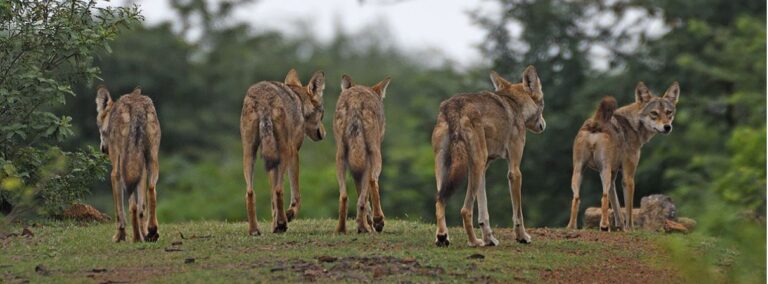
    Image: A pack of wolves in Nandurbar, Maharashtra by The Grasslands Trust

    WHO Global Centre for Traditional Medicine in India

    The centre is being set up to develop norms, standards, and guidelines in relevant technical areas, tools and methodologies, for collecting data undertaking analytics, and assess impact in the area of traditional medicine. 

    A host country agreement has been signed between the Government of India and the World Health Organization (WHO) to establish a WHO Global Centre for Traditional Medicine (WHO GCTM) in Jamnagar, Gujarat.

    The WHO GCTM will be established under the ministry of AYUSH.  This would be the first and only global outposted centre for traditional medicine.

    The centre is being set up to develop norms, standards, and guidelines in relevant technical areas, tools and methodologies, for collecting data undertaking analytics, and assess impact in the area of traditional medicine. It envisages a WHO traditional medicine informatics centre by creating a collaboration of existing data banks of traditional medicines, virtual libraries, and academic and research institutes.

    It will also engage in developing specific capacity building and training programmes in the areas of relevance to the objectives and conduct training programmes in campus, residential (or web-based), and through partnerships with the WHO Academy and other strategic partners.

    While the centre will help position AYUSH systems across the globe and provide leadership on global health matters pertaining to traditional medicine, it will also ensure quality, safety and efficacy, accessibility and rational use of traditional medicine.

    WHO Director General Tedros Adhanom Ghbereyesus announced the establishment of WHO GCTM in India on 13 November 2020 as a centre of global wellness that will bolster evidence-based research, training and awareness for traditional medicine.

    Leadership on traditional medicine

    A joint task force has been constituted for coordination, execution and monitoring of activities for the establishment of this centre.  The task force comprises representatives from the India and WHO. To begin with, an interim office will be established at Jamnagar to execute the identified technical activities and planning of fully functional WHO GCTM.

    The interim office is intended to generate evidence and innovation, artificial intelligence based solutions for traditional medicine, systematic reviews in collaborations and delve into socio-cultural and biodiversity heritage.

    The WHO GCTM would provide leadership on all global health matters related to traditional medicine as well as extend support to member countries in shaping various policies related to traditional medicine research, practices and public health.

    The ministry of AYUSH has collaborated with WHO on many fronts including developing benchmarks documents on training and practice of ayurveda and unani systems, developing apps like M-yoga and will support the work of the international pharmacopeia of herbal medicine.

    The WHO-GCTM will identify various challenges faced by the countries in regulating, integrating and further positioning traditional medicine in respective countries. Traditional medicine is a key pillar of health care delivery systems and plays a crucial role in maintaining good health and well-being.  Safe and effective traditional medicine will play a significant role in ensuring all people have access to quality essential health care services and safe, effective and affordable essential medicines as the world approach the 10-year milestone for Sustainable Development Goals in 2030.


    Image: Hippopx, licensed to use under Creative Commons Zero – CC0


    After Bangladesh, river meetings in India address riparian challenges

    River meetings – or ‘Nodi Boithoks’ – empowered under-threat and overlooked river communities in Bangladesh to have a say in critical conversations about their difficulties; now India is following suit.

    By Deepmala Ghosh, Saurabh Kumar, Zobaidur Rahman

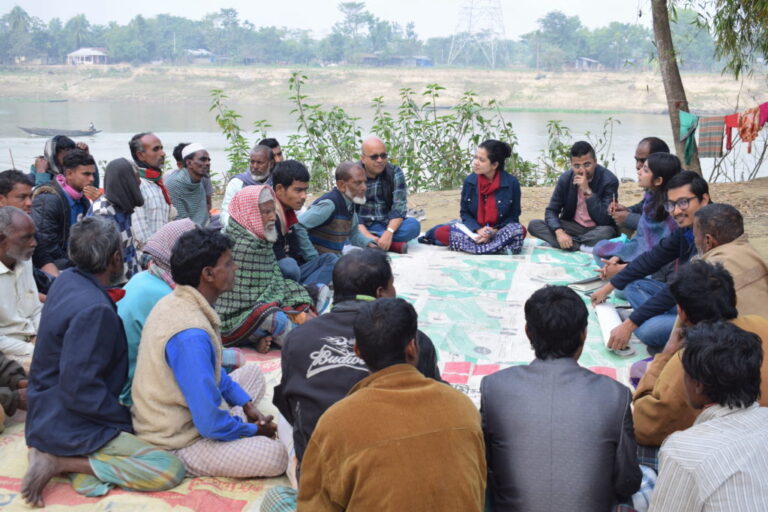
    Rajrajeshwar, a tiny river island (locally called char) in the Meghna River in Bangladesh’s Chandpur district, is home to around 43,000 people. The island is extremely vulnerable to intense river erosion during floods, forcing families to sleep under the open sky when the flood hits.

    Chandpur is located near the confluence of Bangladesh’s two mighty river systems: the Padma and the Meghna. Every year, flood waters from the northern region flow into the Bay of Bengal via the Padma and Meghna rivers in Chandpur, driving erosion.

    Residents of Rajrajeshwar char allege that apart from the floods, illegal sand mining is a major factor behind erosion and that the indiscriminate extraction of sand from the rivers poses threats to fisheries and river ecosystems.

    According to Bangladesh’s Sand Quarry and Soil Management Act of 2010, sand extraction is allowed only at designated sites, which only the government can demarcate. But the island community has been largely unable to raise the issue of violations, as its members have been left out of decision-making. The conversation is dominated by elite businessmen who stand to profit from sand mining operations.

    Salam (he uses only one name), a fisher and a resident of Rajrajeshwar, told The Third Pole, “Sand miners extract sand from both the Meghna and Padma rivers, so we face erosion from both sides.”

    The Nodi Boithok platform

    The widespread practice of indiscriminate sand extraction and the potential threat of erosion were only flagged as issues when residents of Rajrajeshwar had the opportunity to take part in a Nodi Boithok or ‘river meeting’. The process led to a national consultation with civil society organisations, scientists and activists in the capital Dhaka. Recommendations from the national dialogue were shared with the National River Conservation Commission (NRCC) and the National Human Rights Commission (NHRC) of Bangladesh.

    The Nodi Boithok is a process through which civil society and vulnerable communities work collectively to identify water governance challenges and opportunities at the grassroots level. Initiated in early 2018 in Bangladesh by the Oxfam-led Transboundary Rivers of South Asia (TROSA) programme, the concept was later adopted by international NGO CUTS International (Consumer Unity & Trust Society), a partner of the TROSA programme in India.

    The programme is designed to build the capacity of communities to secure their water resource rights by engaging with and influencing policymakers and bureaucrats.

    One of the most significant outcomes of the initiative in Bangladesh has been community-led indigenous river erosion control infrastructure, which was taken to the transboundary level (India and Bangladesh) through dialogue and cross-border visits among communities and civil society organisations.

    The TROSA programme, working across Bangladesh, India, Nepal and Myanmar, aims to understand and address challenges related to transboundary rivers, and work together to create conditions that reduce poverty in communities living in the Ganga-Brahmaputra-Meghna (GBM) and the Salween River basins.

    More than 200 Nodi Boithoks were held across 35 different locations in Bangladesh between 2018 and 2021.

    ‘River meetings’ come to India

    In India, CUTS International organised 20 Nodi Boithoks in 2021 along transboundary rivers in West Bengal and northeast India (Assam and Tripura), namely the Barak, Raidak (Doodhkumar), Jaldhaka (Dharla), Gomti, Manu, Feni, Muhuri and Khowai rivers.

    River meetings nodi boithak civil society voluntary community river management sand mining

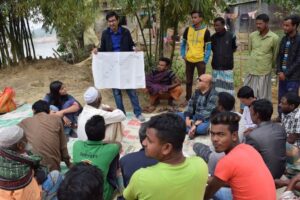
    At these meetings, the socioeconomic and livelihood challenges of people at the grassroots level are highlighted. Their voices are critical to the successful implementation of policies related to river governance, regional cooperation and cross-border engagements.

    The village-level meetings take place each month among communities living nearby in the Brahmaputra and Meghna basins in Bangladesh and India.

    Each meeting is organised by the programme implementing partners, who use reflections from the Nodi Boithoks to forge partnerships with relevant civil society organisations.

    Together, they determine whether the issues being flagged require substantiation of evidence, and also conduct an analysis of the stakeholders involved.

    The most pressing issues across multiple geographic locations covering shared river basins are selected for advocacy. Civil society organisations make an initial ‘influencing plan’ in partnership with communities. With time, this has escalated to the national and basin levels.

    Why community-led solutions are critical

    Rivers in South Asia are governed as state-owned common pool resources. Communities in these river basins have been detached from the governance system for years, despite the existence of water policies aiming at a participatory governance model.

    This has increased vulnerabilities and poverty among river-dependent communities. Even when communities highlight grievances over the encroachment of floodplains and riverbanks, demand flood and erosion protection infrastructure, or bring attention to shortages of water for irrigation and drinking, their efforts die at the grassroots level.

    This is mainly because river governance is often viewed by authorities as a ‘big matter’ that these communities should not design solutions to – even though the brunt is very much borne by them.

    This pretext has compelled the TROSA programme to play the role of a catalyst for community-led initiatives to uncover the root causes of the most pressing concerns and foster partnerships with an aim to achieve inclusive and equitable solutions.

    Nodi Boithoks play a vital role here: they advocate for community members, who are true stakeholders in the riparian economy, to flag their concerns.

    The communities have demanded that the government impose strict restrictions on sand mining and stone-lifting activities.

    Enamul Mazid Khan, country director for Oxfam in Bangladesh told The Third Pole, “Nodi Boithoks have been our effort to create a space for the most marginalised communities of the GBM river basins to talk about shared issues and vulnerabilities around water resource governance and to raise voices about their rights. We have found that these meetings helped the communities gain confidence in themselves, especially the women, about their rights and entitlements. With the continuation and mainstreaming of this process across the shared river basins, more inclusive water governance in the GBM basin is possible.”


    This piece has been sourced from The Third Pole

    Image: Oxfam India

    Air raid sirens, a baby’s first cry: A first-time mother speaks on giving birth during conflict in Ukraine

    A 25-year-old woman living in the Ukrainian capital Kyiv, started having contractions on 24 February, the day the Russian Federation launched a military offensive in Ukraine, and gave birth amid the sounds of air raid sirens. Her name is Mariia Shostak and she describes the harrowing conditions she endured, bringing a new life into a world of sudden and extreme danger.

    This is Mariia Shostak’s story.

    Mariia Shostak

    “I had a complicated pregnancy so I went to the maternity hospital early so that the child and I would be under doctor supervision. When I woke up on 24 February, my phone’s screen was full of messages from relatives. Even before reading, I realized something had happened. The same morning, I had light contractions. In the afternoon, we were evacuated to the basement shelter for the first time. It was scary. At night, I did not sleep. The contractions intensified, and the news did not give peace.

    In the early morning of 25 February, a doctor examined me and told me that I would give birth that day. I called my husband at home to come. A trip that normally takes 20 minutes took almost four hours because of queues at the gas station, shop and pharmacy.

    I was lucky with the birth – it did not happen in the basement though some women gave birth in a room set up for this purpose. I started in the delivery room but had to be transferred to the operating room for a Caesarean section. Later, when air raid sirens went off, the medical staff wanted to evacuate me to the basement, but I refused. Because of the pain, I couldn’t even speak, let alone go anywhere. The rest of the time I was disconnected from the outside world, which was probably the only time I forgot about the war.

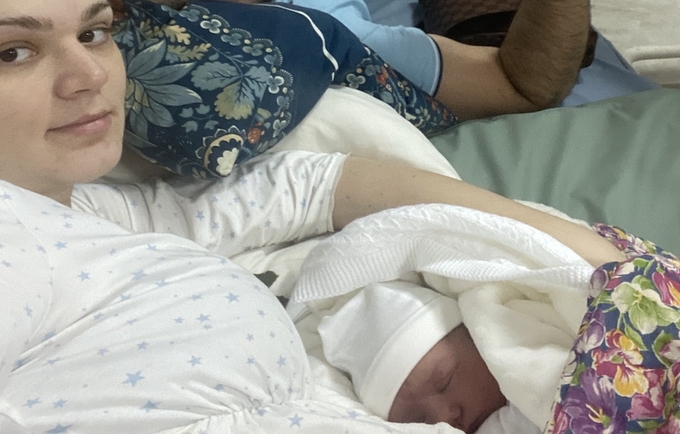
    After the operation, I was in intensive care for several hours, no longer on anaesthesia. I was worried that I didn’t know where the baby and my husband were. Meanwhile, another air raid siren sounded, and I decided to go down to the basement. I was in a disposable shirt, without shoes, in a wheelchair, holding a urinary catheter. I was covered with a blanket and taken to the shelter, where I first saw my son. We named him Arthur.

    I felt fear, fatigue and pain. The day after surgery, I went up to the maternity ward and back down to the basement several times a day. Again and again, the air raid siren sounded. I managed to sleep for an hour or two a day. We spent most of the time in the basement sitting in chairs. My back hurt from sitting, and my legs are still swollen as a pregnancy complication. Exhaustion blunted the fear until a projectile hit a high-rise building we could see from our window.

    Baby born Ukraine Russia war
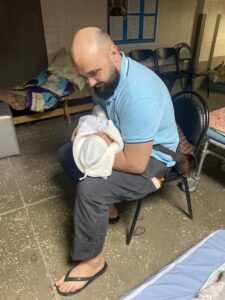
    Mariia’s husband, Yurii, holds his newborn son at the hospital. They plan to stay in the basement of their home for now.

    My husband, Yurii, helped me, taking care of me and the newborn. Medical staff organized meals in the bunker and later provided beds. They helped put the baby to the breast, shared medicine for babies, held my hand when I had a hard time walking.

    I feel safe in the capital – there are enough shelters and timely information is coming from the authorities. My husband arranged a corner for us in the basement of our house to stay. I was born and raised here in Kyiv, I have no other home. We are not going to leave.”


    Mariia Shostak is a 25-year-old woman living in Kyiv who started having contractions on 24 February, the day the Russian Federation launched a military offensive in Ukraine.

    Image: Mariia Shostak via UNFPA

    Veto is the Chief Culprit but Expulsion or Suspension is Not the Remedy

    Why have Russia and the People’s Republic of China not called for an amendment of the UN Charter to streamline their membership issue? All Permanent Members are fully cognizant that that would open up a Pandora’s box, including the issue of abolition of veto and other reform issues which are not at all to their liking as part of the P-5 coterie.

    By Ambassador Anwarul K Chowdhury

    The ongoing war in Ukraine has raised the question of expulsion or suspension of the Russian Federation from the United Nations. As is known, following the dissolution of the Soviet Union in 1991, its UN seat was transferred to the Russian Federation.

    With the collapse of the USSR in late 1991,the Commonwealth of Independent States signed a declaration agreeing that “Member states of the Commonwealth support Russia in taking over the USSR membership in the UN, including permanent membership in the Security Council.”

    USSR Ambassador to UN transmitted to the UN Secretary-General a letter from President of the Russian Federation stating that:

    “… the membership of the Union of Soviet Socialist Republics in the United Nations, including the Security Council and all other organs and organizations of the United Nations system, is being continued by the Russian Federation with the support of the countries of the Commonwealth of Independent States. In this connection, I request that the name ‘Russian Federation’ should be used in the United Nations in place of the name ‘the Union of Soviet Socialist Republics’. The Russian Federation maintains full responsibility for all the rights and obligations of the USSR under the Charter of the United Nations, including the financial obligations. I request that you consider this letter as confirmation of the credentials to represent the Russian Federation in United Nations organs….”

    The Secretary-General circulated the request among the UN membership. There being no objection, the Russian Federation took the USSR’s place, with President Boris Yeltsin personally taking the Russian Federation’s seat at the Security Council meeting on 31 January 1992.

    Without presenting new credentials. USSR Ambassador to UN continued serving as the first Permanent Representative of the Russian Federation to the United Nations.

    UN’s working arrangements

    Since its inception, the United Nations has resorted to all kinds of measures, practices, and procedures to circumvent the complexities of an intergovernmental decision-making and legal implications, heavily influenced by the position or opposition of the five permanent members of the Security Council.

    As a result, acquiescence in its various manifestations has become all pervasive in the business of the United Nations. A clear manifestation of that is practiced these days through what is known as “silent procedure” whereby the reluctant acceptance of Member States of all kinds of anomalies achieve an agreement or consensus otherwise not possible.

    The Russian veto on the Ukraine resolution in the Security Council prevented unanimous global resolve to address the situation there. The continuation of veto is an aberration of the multilateral system as practiced in the UN Security Council, thereby jeopardizing all the positive UN efforts to maintain international peace and security.

    Change in multilateral system

    The war in Ukraine has reaffirmed more clearly than ever that the “global ideological struggle” that had for so long dominated the international scene does not exist anymore. And the new realities must be translated into a different set of global institutions unless the existing one undertake major and all-pervasive reforms of their decision-making and operational practices and procedures.

    The expulsion or suspension of one of the five veto-wielding permanent members would not necessarily result in effective maintenance of the global peace and security. There would still be four others with the ability to deny any time a consensus decision with which any one of them does not agree.

    Veto, the chief culprit

    The chief culprit in the failure of unified global action by the UN is the continuation of the irrational practice of veto. As a matter, I have said on record that, if only one reform action could be taken, it should be the abolition of veto. Believe me, the veto power influences not only the decisions of the Security Council but also all work of the UN, including importantly the choice of the Secretary-General.

    I believe the abolition of veto requires a greater priority attention in the reforms process than the enlargement of the Security Council membership with additional permanent ones. Such permanency is simply undemocratic. I believe that the veto power is not “the cornerstone of the United Nations” but in reality, its tombstone.

    The case of China

    Unlike the question of the replacement of USSR membership by the Russian Federation in 1991, the case of the recognition of the People’s Republic of China (PRC) by the UN is straightforward.

    It was decided by the apex body of the UN system, the General Assembly in its groundbreaking resolution 2758 titled “Restoration of the lawful rights of the People’s Republic of China to the United Nations” which was adopted by two-thirds majority on 25 October 1971 in accordance with the UN Charter.

    The resolution recognized the People’s Republic of China as “the only legitimate representative of China to the United Nations” and expelled “forthwith the representatives of Chiang Kai-shek” from the United Nations.

    Following adoption of Resolution 2758, the Beijing government began representing China at the UN from 15 November 1971 and its delegates were seated at the UN Security Council meeting held on 23 November 1971, the first such meeting where representatives of the Beijing government represented China with its veto power as a permanent member of the Council.

    UN’s clear position on Taiwan

    Over the years, Taiwan’s efforts to revive the application for UN membership separately for itself has received no support of the UN membership in general.

    Reflecting the long-standing UN policy is mirrored in the “Final Clauses of “Final Clauses of Multilateral Treaties, Handbook”, 2003 published by the UN, stating that:

    “…regarding the Taiwan Province of China, the Secretary-General follows the General Assembly’s guidance incorporated in resolution 2758 (XXVI) of the General Assembly of 25 October 1971 on the restoration of the lawful rights of the People’s Republic of China in the United Nations. The General Assembly decided to recognize the representatives of the Government of the People’s Republic of China as the only legitimate representatives of China to the United Nations. Hence, instruments received from the Taiwan Province of China will not be accepted by the Secretary-General in his capacity as depositary.”

    It is relevant to recall that in 2007, Secretary-General of the UN Ban Ki-moon rejected Taiwan’s membership bid to “join the UN under the name of Taiwan”, citing Resolution 2758 as acknowledging that Taiwan is part of China, although it is important to note, not the People’s Republic of China.

    Why not amend the Charter

    I have confronted on many occasions the question why Russia and PRC have not called for an amendment of the UN Charter to streamline their membership issue. For that, my opinion is that all Permanent Members are fully cognizant that that would open up a Pandora’s box, including the issue of abolition of veto and other reform issues which are not at all to their liking as part of the P-5 coterie.


    Ambassador Anwarul K Chowdhury, is Former Permanent Representative of Bangladesh to the UN; President of the UN Security Council (2000 and 2001); Senior Special Adviser to UN General Assembly President (2011-2012) and Former Under-Secretary-General and High Representative of the UN.


    This piece has been sourced from Inter Press Service

    Image: United Nations


    Afghanistan: Journalists live under threats from Taliban

    Authorities in Afghanistan censor the work of journalists and even resort to beating up journalists covering issues that the Taliban finds discomforting.

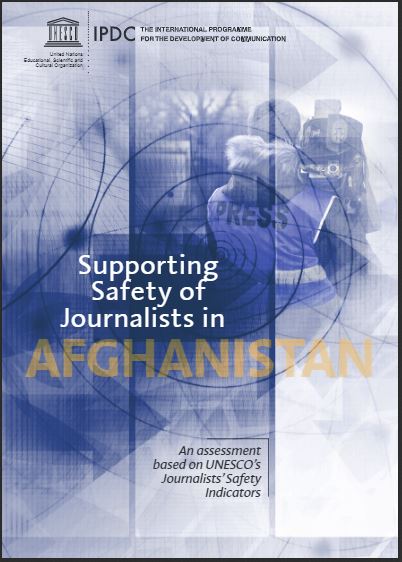
    Taliban authorities have carried out far-reaching censorship and violence against Afghan media in district and provincial centres, says Human Rights Watch.

    This has drastically limited critical reporting in Afghanistan, particularly impacting journalists outside the capital city Kabul. Women journalists are worst affected and face the most intense repression.

    Journalists in the provinces described Taliban members threatening, detaining, and beating them and their colleagues who were trying to report the news, HRW says, adding that many journalists have felt compelled to self-censor and report only Taliban statements and official events.

    “Taliban harassment and attacks on journalists outside major urban areas have largely gone unreported, causing media outlets in outlying provinces to self-censor or close altogether,” said Fereshta Abbasi, Afghanistan researcher at Human Rights Watch. “In many provinces, the Taliban have virtually eliminated reporting on a wide range of issues and have driven women journalists out of the profession.”

    On February 2, 2022, the Taliban spokesperson, Zabihullah Mujahid, told a meeting of the Afghan Journalists Safety Committee, a media advocacy group, that journalists should consider “national interests, Islamic values, and national unity” before publishing. He said that a new media commission would be established to address any problems, and that the authorities would enforce the former government’s media law. He also said without elaborating that “women can work freely in the media by observing Islamic and national principles.”

    Music on radio and television has disappeared since the Taliban took over. Even advertisements were not allowed to play background music. A journalist in Kapisa said, “there are no longer any political shows or live programs; these have been replaced with more Islamic programs.”

    Restrictions, fear

    The HRW report speaks of journalists throughout Afghanistan facing severe restrictions on doing their work by the Taliban. This is in violation of the Afghan media law and international human rights standards on freedom of expression and the media. An estimated 80 percent of women journalists across Afghanistan have lost their jobs or left the profession since the Taliban takeover in August 2021, and hundreds of media outlets have closed.

    The HRW study involved 24 journalists and other media workers in 17 of the country’s 34 provinces. Journalists in each of these provinces said the Taliban actively monitor their publications and compel them to share the content of their reports with the provincial directorate of information and culture before publication. Many of the journalists said that Taliban intelligence officials regularly meet with media organizations to tell them what to publish and to warn them not to contradict Taliban policies or to report on acts of violence by Taliban officials.

    “We all fear for our safety,” a reporter in Baghlan said. “If something happens to a journalist, there is no institution or system to support them, or to seek justice. There is no support for the media workers in Afghanistan right now.”

    Thrashed

    Many journalists said they or their colleagues had been beaten for trying to report on anti-Taliban protests, arbitrary detention, rising food prices, and other subjects that cast Taliban officials in a bad light. In some provinces, Taliban officials told all women journalists to stop working. The few who are allowed to work can no longer have roles in which they come face-to-face with the public.

    “Getting the news from Afghanistan’s rural areas has never been easy, but the Taliban’s repression of the media in the provinces is dangerous both for the journalists and the people whose lives are harmed by unreported abuses,” Abbasi said. “Governments should press the Taliban to end to all attacks on the media, whether in Kabul or the countryside.”

    A female journalist in Balkh said that, in September, Taliban soldiers had beaten her on the street while she was trying to cover women’s protests. She said: “Journalists can easily get beaten by Taliban soldiers in the streets and no one will be held responsible. In the past few months, a journalist from Arezo TV has been beaten and a Pajhwak journalist in Balkh has been arrested.”

    A journalist in Kandahar said that, in December, Taliban members beat him while he was on the street preparing a report on the rise in food prices. That month, the Taliban detained two journalists and badly beat them in custody. One was released after a few hours, the other after six days. Their colleague said that both have remained under surveillance.

    An editor working outside of Kabul said that, in December, one of his journalists went to the passport office to report on the difficulties Afghans were having obtaining passports. A member of the Taliban police badly beat him and confiscated his camera.

    Nepal to begin talks with UK on Equality for Gurkhas

    The Gurkha’s struggles for pay parity are steeped in history. Retired British Gurkha soldiers were left to fight a lonely battle for their salaries, perks and pensions thus far.

    The government of Nepal has decided to join talks with the British government on the pension-related demands of Britain’s ex-Gurkha soldiers. The issue of an equality in pensions is a long-pending demand of the Gurkha soldiers.

    Nepal’s newly appointed ambassador to UK, Gyan Chandra Acharya to lead the discussion with the British government. Nepal’s ministry of foreign affairs wants the ambassador to prioritise the discussions.

    Discussions are on with members of ex-Gurkha servicemen associations to prepared the grounds for the talks.

    In July 2021, a group of veteran British Gurkha soldiers staged a 13-day long relay hunger strike close to Downing Street, the seat of power. The hunger strike was organized by the British Gurkha Satyagraha United Struggle Committee (BGSUSC), a group formed to carry out the campaign for equal pension for the Gurkhas, besides other demands.

    Campaign for equality

    They started a campaign for “justice” in 1990 in Nepal led by different associations of former soldiers. In 2009, the Gurkhas were granted the right of abode in the UK which meant that they could move to live in UK – a move best with cultural incompatibilities and harsh living conditions on measly pensions.

    Years of negotiations have meant that Gurkha soldiers recruited in later years are not as discriminated. But the retired soldiers have been left to fight a lonely battle for their salaries, perks and pensions thus far.

    A list of 13 demands prepared by the BGSUSC in May 2021 and rallies and a relay hunger strike have yielded little – eventually bringing the Nepal government into the picture. The pressure to deliver is now on the country’s new ambassador.

    Nepal is not a member of the Commonwealth either and the present talks are also prompted by a debate in Nepal about letting its young people fight the battles of a distant country.

    Every year, thousands of young Nepalis compete for employment with the British army’s Brigade of Gurkhas and the Gurkha contingent of the Singapore police. There are even training academies that have sprung up, training them for the physical tests as well as rudimentary three-Rs.

    History of discrimination

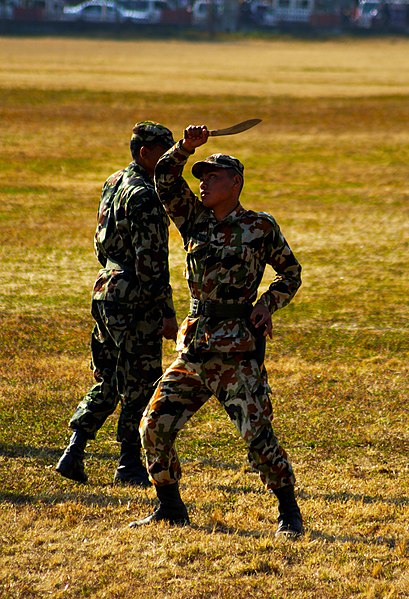
    The Gurkha campaign has a 30-year-long history. Or actually, over two centuries since the Gurkhas began serving the British Crown in 1815 – starting with three regiments to fight the British battles, including the wars against the Marathas (1817-19), the Jats (1824-26) the two Sikh wars (1845-46 and 1949), the second Afghan war of 1878-80 and the Burma war of 1885.

    Over two lakh Gurkhas also served the British army during the first and second world wars.

    The Gurkhas were not paid from the UK treasury. Instead, their salaries were sourced from colonial governments in Malaysia, Singapore, and Hong Kong, calculating their remuneration dues on living standards in Nepal.

    Many soldiers returned to Nepal complaining about a lack of compensation. The Gurkhas were paid less than their counterparts in the British Army and this disparity also reflected in their pensions.


    Image: Wikimedia. Picture by Stig Berge