More

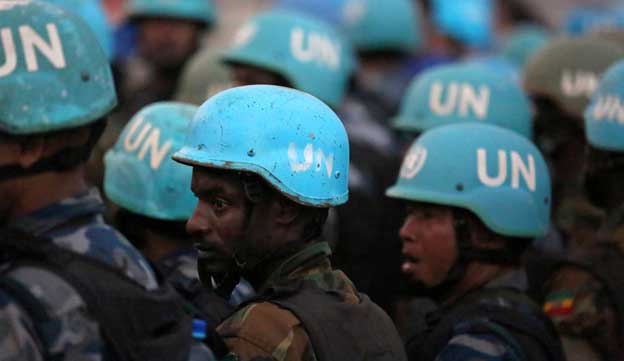
    UN’s Political Hypocrisy– as Multi-Million Dollar Purchases Continue from a Blacklisted Russia

    The UN has rules and guidelines for ethical behaviour of suppliers and contractors. But the violation of a country’s sovereignty and the invasion of a member state are not part of those rules.

    The world’s financial institutions, primarily in the US and Europe, have cut off links and economically ostracized Russia for its invasion of Ukraine and violation of the UN charter.

    UN Secretary-General Antonio Guterres lambasted the Russians declaring the military invasion “a violation of the territorial integrity and sovereignty of Ukraine– and inconsistent with the principles of the Charter of the United Nations.”

    The White House announced last week that the United States and allies will kick certain Russian banks out of a major international banking system, a significant step in a bid to cripple the Russian economy.

    Meanwhile, the International Criminal Court in The Hague, has already announced plans to launch a war crime investigation of Russia’s invasion of Ukraine.

    But despite the fact that Russia has been politically and economically isolated as an international pariah, the UN Secretariat is continuing its relationship with Russian companies — buying goods and services, primarily relating to air transportation, information and communication technologies (ICT) and food catering, mostly for the UN’s 12 peacekeeping missions.

    UN trade links

    The approved budget for UN Peacekeeping operations for the fiscal year 1 July 2021 – 30 June 2022 is a staggering $6.38 billion. (A/C.5/75/25) — and payments to Russian contractors will flow largely from this budget.

    An equally valid question is: how will the UN pay for these purchases and services when Russians have been barred from most of the international banking system.

    Last week, the US, Canada and Europe tightened financial restrictions on Russia with a new ban that blocks seven Russian banks from using SWIFT, the global messaging system that enables bank transactions. The move was aimed at disrupting Russia’s ability to do business across borders.

    According to the latest available figures, the UN’s purchases from Russia amounted to about $132.3 million in 2020, with Moscow listed as the fifth largest supplier behind UAE, USA, Kenya and Switzerland.

    The UN also has trade links with Russia’s largest helicopter operator, UTair – Helicopter Services, described as a leading provider of aviation services to companies in the fuel and energy industries, plus the United Nations.

    There have also been rumors that some of the contracting firms have links to Russian oligarchs and high-ranking political officials who have been crippled by US and Western European sanctions.

    But apparently not at the United Nations. An Asian diplomat characterized it as UN’s “sheer political hypocrisy”.

    War and ethical behaviour?

    US Secretary of State Antony J. Blinken said February 25 the United States is inflicting unprecedented costs on President Putin and those around him for their brutal and unprovoked assault on the people of Ukraine.

    “We are united with our allies and partners in our commitment to ensure the Russian government pays a severe economic and diplomatic price for its further invasion of Ukraine, a sovereign and democratic state”, he added.

    Meanwhile, the head of the UN’s Department of Operational Support, did not respond to two messages — seeking comments on the continued UN trade and economic relationship with Russia.

    But Farhan Haque, the UN’s deputy spokesperson, was more forthcoming, when he told IPS: “What we can say is that if specific UN sanctions were imposed on the Russian Federation, or sanctions against a particular company or their principals that would affect their ability to perform, then of course we would comply.”

    The UN does, however, lay down strict rules and guidelines for ethical behaviour of suppliers and contractors. But the violation of a country’s sovereignty and the invasion of a member state are not part of those rules.

    UN core values

    According to UN guidelines, suppliers and contractors must comply with the United Nations Supplier Code of Conduct and General Conditions of Contract, in particular, the provisions on sexual exploitation, child labour, discrimination, conditions of work and harassment.

    The UN Procurement Division also reminds the UN supplier community, that as a UN registered supplier “you have accepted the United Nations Supplier Code of Conduct, which reflects the core values outlined in the Charter of the United Nations” But a blatant violation of that same charter is apparently not a reason for expulsion.

    Meanwhile, the killing spree continues. As of March 3, more than 250 were killed and over 550 injured in continued attacks by Russian military forces inside Ukraine.

    The UN has warned that while the scale and scope of displacement is not yet clear, it is expecting more than 10 million people to flee their homes if violence continues, including 4 million people who may cross borders to neighbouring countries triggering a major humanitarian crisis in Europe.


    This piece has been sourced from Inter Press Service


    Image: UN

    Sri Lanka’s fertiliser sell out to China

    China’s arm-twisting tactics are adding to Sri Lanka’s woes as the island nation struggles with foreign currency reserves and teeters on the edge of a grim economic precipice. 

    By Shakthi De Silva

    Sri Lanka is saddled with annual foreign debt settlements of US$4.5 billion for the foreseeable future. Notions of an investment friendly hub are satirised by the reality on the ground, with people standing in long queues waiting for daily essentials like milk powder and gas cylinders for cooking. These developments come amid an economic slowdown brought about by COVID-19, poor fiscal and monetary policies, and an abrupt decision to ban the importation of chemical fertiliser which gravely impacted local harvests.

    The decision was made in April 2021 by an ‘out of touch with reality’ President Gotabaya Rajapaksa who believed that a prohibition on chemical fertiliser would increase his popularity as a promoter of organic farming and save much needed US dollars flowing out of the country. His attempt to proverbially ‘kill two birds with one stone’ backfired dramatically. Protests erupted throughout the country as farmers took to the streets demanding the continued importation of chemical fertilisers or the provision of a substitute organic fertiliser.

    Disregarding local laws

    The Gotabaya regime reached out to China and imported organic fertiliser from Qingdao Seawin Biotech. Initial tests on samples carried out in Sri Lanka confirmed that Qingdao’s fertiliser contained a  microorganism identified as ‘Erwinia’ which could cause crop failure. The Ceylon Fertilizer Company halted payments to Qingdao Seawin Biotech for the organic fertiliser. The Colombo High Court promptly ordered Sri Lanka’s People’s Bank to freeze the disbursement. The ship carrying the consignment of Chinese fertiliser was also denied entry into Sri Lankan ports.

    Qingdao Seawin Biotech responded by demanding a US$8 million compensation from Sri Lanka’s National Plant Quarantine Services, asserting that failure to pay the sum in three days would result in legal action. The Chinese Embassy in Colombo tweeted that Sri Lanka’s People’s Bank would be blacklisted for freezing payments, despite the bank simply adhering to the High Court’s ruling. A local journalist observed that, ‘by slapping sanctions on People’s Bank, China could be showing disregard for domestic legal procedures, despite consistently maintaining internationally that it respects each country’s local processes, independence and sovereignty’.

    The ship did not return to China after being blocked from entry to Sri Lanka. Instead, it left for Singapore and reportedly changed its name. Vessel tracking technology helped reporters locate the ship in Hambantota in southern Sri Lanka where China currently manages a port under a 99 year lease.

    China’s heavy-handed approach forced the Sri Lankan government to back down. A government spokesperson stated that 75 per cent of the US$8 million will be paid out as compensation to Qingdao Seawin Biotech, despite Sri Lanka’s foreign exchange crisis. Sri Lankan Agriculture Minister Mahindananda Aluthgamage admitted that, ‘we cannot afford to damage diplomatic relations over this issue’. This highlighted the degree of leverage that China exercised.

    China’s bitter pill

    Recent reports indicate that Sri Lanka plans to order a new consignment of organic fertiliser from Qingdao Biotech even though the company doubled the price of fertiliser that was initially agreed upon by the two parties. The Agriculture Minister also designated a committee to alter quality standards to enable Qingdao Biotech’s fertiliser to be imported and, in a move to conform to Qingdao’s demands, fertiliser samples will be tested in a laboratory recommended by the company. The incident reflects Beijing’s ability to arm-twist small states when they challenge a Chinese firm or the Chinese government’s stance.

    Sri Lanka’s weak economic position, coupled with the Rajapaksa family’s past connections with Chinese President Xi Jinping, undermines Sri Lanka’s ability to exercise independent agency and autonomy. The fertiliser debacle also demonstrates the likelihood that small states — particularly ones facing economic hardships relating to debt repayment — will be forced to swallow China’s ‘bitter pill’ regardless of whether it is in the national interest of the country.


    Shakthi De Silva is a Visiting Lecturer at the Bandaranaike Centre for International Studies and is currently pursuing his postgraduate studies at the National University of Singapore.

    This piece has been sourced from East Asia Forum of the Australian National University

    UN body urges Canadian government to amend discriminatory Indian Act

    Under Canada’s Indian Act, the federal government maintains that indigenous people must have “status Indian” registration to be able to access to rights and benefits.

    The UN Committee on the Elimination of Discrimination against Women (CEDAW) called on Thursday, for Canada to fully address long-standing gender-based discrimination in its Indian Act, which continues to affect tens of thousands of descendants of indigenous women today.

    In the findings, the Committee found that, by being prevented from passing their indigenous status onto new generations, J.E.M. – a matrilineal indigenous descendant from a long line of leaders of the Capilano Community – and his children, were victims of violations rooted in the discriminatory nature of Canada’s Indian Act, the primary law used to administer indigenous peoples.
    Native Indigenous Canada Canadian Indian
    Losing his ethnicity
    The committee cited the case of J.E.M., whose grandmother was a member of the indigenous Squamish Nation in British Colombia.
    She was forcibly taken from her community and placed in a residential school to assimilate her and other indigenous children into Euro-Western culture.
    His grandmother was made to learn English and practice Christianity, and later married a non-indigenous man, which, according to the Indian Act, meant that she was no longer indigenous.
    “The entire issue stems from the disrespect of indigenous people’s fundamental right to self-identification,” said Committee member Corinne Dettmeijer.
    Piecemeal exceptions
    Under the Act, the “status Indian” registered with the federal Government, is a condition for gaining access to rights and benefits, such as health-care services, financial support for education, the rights to reside on indigenous territories and hunt and fish on indigenous traditional lands.
    Prior to 1985, the Indian Act contained explicitly discriminatory provisions against women, including taking away their status if they marry non-indigenous men. Since then, despite numerous legal challenges, Canada has only amended the discriminatory provisions with piecemeal changes rather than ending the discrimination entirely.
    As J.E.M. is a disenfranchised matrilineal indigenous descendant, he was denied his indigenous identity until 2011, when he could only recover limited status.
    And it was not until 2019 that J.E.M.’s children were recognized as indigenous.
    However, under the Indian Act, they will not have the right to freely pass their indigenous status on to the next generation.
    CEDAW found that by being prevented from passing their indigenous status on to new generations, JEM and his children were victims of violations.
    “It is further exacerbated by the unequal criteria by which men and women are permitted to transmit indigenous status and identity to their descendants,” Corinne Dettmeijer asserted.
    Legislation need amending
    After multiple failed attempts to challenge the Indian Act in Canada, J.E.M brought his petition to CEDAW, which declared provisions of the Indian Act discriminatory to the descendants of disenfranchised indigenous women.
    “Descendants of indigenous Indian grandfathers would never have lost their status and have always been able to pass on their status to their children,” Dettmeijer pointed out.
    Totem pole Native Indian Vancouver
    The Committee recommended that Canada provide appropriate reparation to J.E.M. and his children, including recognizing them as indigenous people with full legal capacity, and allowing them to freely transmit their indigenous status and identity to their descendants.
    It also called on Canada to amend its legislation to enshrine the fundamental criterion of self-identification, and to provide registration to all matrilineal descendants on an equal basis to patrilineal descendants.


    Image: Hippopx, licensed to use under Creative Commons Zero – CC0

    Education: Budget cuts funds for minority education bodies

    Muslims and other religious minorities in India have been lagging behind on development indicators pertaining to educational attainment, gender equality and workforce participation. 

    Jawed A Khan

    Despite several minority development initiatives by the government, Muslims and other religious minorities in India have been lagging behind on development indicators pertaining to educational attainment, gender equality and workforce participation. It is found that Muslims account for the highest proportion of out of school children (4.43 per cent) in the country.

    Over the last couple of decades, there have been two policy strategies focusing on the development of religious minorities in the country. They are the Prime Minister’s New 15 Point Programme (15 Point Programme) for welfare of minorities and the Multi Sectoral Development Programme (MSDP), introduced in 2006 and 2008, respectively. The MSDP was renamed as the Pradhan Mantri Jan Vikas Karyakram (PMJVK) in 2018. With regard to the interventions under these policy strategies, the 15 Point Programme for the welfare of minorities focuses on enhancing opportunities for education, an equitable share in economic activities and employment, improving living conditions, and prevention and control of communal riots.

    Resources allocated

    No new scheme has been announced for the development of minorities nor have minorities been mentioned in the Union Budget speech for 2022-23. There is a hike of four per cent in the Union Budget over the previous year’s budget (an increase of Rs 210 crore) for the Union Ministry of Minority Affairs, based on a small increase in allocations for the PMJVK. The total budget of the ministry as a proportion of the total Union Budget, however, has declined to 0.12 per cent in 2022-23 (BE) from 0.14 percent in 2021-22 (BE).

    The Minority Affairs Ministry’s budget has been increased from Rs 4,820 crore in 2021-22 (BE) to Rs 5,010 crore in 2022-23 (BE) (the 2021-22 revised estimates figure stands at Rs 4,246.05 crore). The ministry utilised only Rs. 3,920.29 crores in 2020-21 (Actuals) against the BE figure of Rs 5,029 crore for the year.  It also seems that the Union Budget outlays have not been provided in accordance with the demands for funds made by the Ministry. For 2019-20 and 2020-21, Rs 4,700 crore and Rs 5,029 crore were allocated against demands from the ministry for Rs 5,795.26 crore and Rs 6,452 crore, respectively.

    In this budget, schemes relating to the post-matric scholarship, merit cum means scholarships and MSDP/PMJVK have seen small increases in allocation from the previous year’s budget, while several other schemes (such as skill development and women leadership schemes) have seen declines in allocation. The budget allocation for the Maulana Azad Education Foundation (MAEF) has been reduced to Rs 0.01 crore from Rs 90 crore in 2021-22. This will affect the implementation of projects such as construction grants to minority institutions and the Begum Hazrat Mahal Scholarship Scheme for meritorious girls.

    The scheme for madrasas and minorities, which was shifted to the Minority Affairs Ministry from the Ministry of Education last year, has received a reduced budget outlay of Rs 160 crore this year (compared to Rs 174 crore in 2021-22). This might affect the education of children in madrasas due to non-payment of honoraria to teachers. The Ministry of Education has reported Rs 310.22 crore in the revised estimates for 2020-21 for this scheme. The scheme provides financial assistance to introduce modern subjects in Madrasas, teachers’ training and augmenting school infrastructure in minority institutions.

    Implementation of scholarship schemes

    Religious minorities, particularly Muslims, require special attention in the area of educational and economic empowerment. The pre-matric, post-matric and merit-cum-means scholarship schemes face implementation issues with poor coverage of beneficiaries and low unit costs due to inadequate allocations of funds. Usually, utilisation of the budget under the scholarship schemes appears to take place in the last quarter of each financial year. The utilisation in the first three quarters of 2020-21 was only 19 per cent (up to December 2020). Thus, beneficiary students may be receiving their scholarships only towards the end of the academic year.

    The Union Government promised to give one crore scholarships to minorities annually under an umbrella scholarship programme (pre-matric, post-matric and merit-cum-means scholarship schemes) in 2019. As against this benchmark, only 58 lakh students received the scholarships provided by the Ministry of Minority Affairs in 2020-21. During the same year, approximately 1.10 crore applications were received for the scholarships. This shows that 47.5 per cent of the total applicants were deprived of scholarship benefits. As for the post matric scholarship scheme, only 36.7 per cent of total applicants received the scholarship that year.

    Allow for customised interventions

    The amounts given to students as scholarships are not adequate to meet their educational expenses. The unit cost for scholarships in pre-matric, post-matric and merit-cum-means has not been revised since the inception of the schemes in 2007. For instance, only Rs 1,000 per annum is provided to day scholars under the pre-matric scholarship scheme. The scheme for post matric scholarship provides financial support of Rs 7,000 per annum in terms of admission and tuition fee for classes XI and XII and maintenance allowance of Rs 380 per month and Rs 230 per month for hostellers and day scholars, respectively. Only 85 institutes for professional and technical courses have been listed under the merit cum means scholarship scheme. A course fee of Rs 20,000 per annum is reimbursed to students studying in other institutions. Besides, the amount provided as maintenance allowance is a meagre Rs 500 per month for day scholars and Rs 1,000 per month for hostellers.

    The CSS guidelines covered under the 15 Point Programme must allow for appropriate or customised interventions for development of minorities by identifying the development gaps in minority concentrated localities and areas. The design of the 15 Point Programme is not appropriate in terms of comprehensive coverage of the minority population and addressing their development needs until and unless the government initiates / designs some targeted schemes / programmes for minorities. In this respect, instead of the current provision of 15 per cent of funding allocation under the 15 Point Programme, resource allocation should be made as per the diverse needs of minority communities across different sectors. Further, the scholarships should be made demand driven, along with additional financial resources to enhance unit costs. The total budget allocation for the Ministry of Minority Affairs should be significantly increased, given the level of deprivation in the educational attainment of minorities.


    Jawed A Khan is with the Centre for Budget and Governance Accountability, New Delhi

    India-Nepal train service struggles to get on track

    Cross border travel will cost a mere 70 Nepali rupees, or less than 50 Indian rupees over a 36 km stretch. But this will have to wait until Nepal’s parliament passes a law to establish the Nepal railway corporation.

    By Laxmi Khanal

    The virtual inauguration of Nepal railway’s service by Prime Ministers Narendra Modi and Sher Bahadur Deuba due later this month has run into rough weather – at least for the time being.

    Successful test runs for the railway line between Jayanagar in India and Kurtha in Nepal have been on since 13 February. The daily dry runs have been accompanied by rising hopes by people eager to commute the route. The railway company has yet to confirm when the service will open to public.

    However, there is a spanner in the works as the ordinance to be placed before Nepal’s parliament to allow for an operational railway system has lapsed. The ordinance, according to the rule book of Nepal’s parliament, was valid for 60 days. The Nepal railway company needs a law in sanctioned by the country’s constitution providing for it.

    Renukumari Yadav, Nepal’s minister for physical infrastructure and transport had put in the ordinance on 30 November 2021. She had then argued that any delay to operationalise the train’s commercial service would put the project in jeopardy.

    The Nepal railway company has collaborated with Indian railway’s Konkan railway cooperation for the establishment of the service that will benefit people from both sides of the border. Konkan railway corporation has supplied two diesel locomotives to chug the trains.

    Nepal, on its part, bought two train sets for 846.5 million Nepali rupees in 2020. The trains were kept wrapped under sheets of tarpaulin.

    Nostalgia

    The twice-daily service will service about 5,000 passenger trips over a stretch of 36 kilometres between the two countries for less than 50 Indian rupees (70 Nepali rupees) over 90 mintues with eight stations enroute. A flight ticket from Janakpur to Kathmandu comes for about 25-times that price.

    The railway is not entirely new to the people of Nepal’s plains – it replaces an earlier, extremely crowded but popular, narrow gauge train service. The tracks were laid in 1927 to carry timber from the then-Himalayan kingdom. The route includes the temple town of Janakpur that has a special mythological significance and the train could be a boon for Indian pilgrims flocking there.

    Besides the nostalgia it has evoked, the new railway service has also had its share of controversies, when last year, the Sher Bahadu Deuba government sacked the railway company’s general manager and over a 100 staff hired by his predecessor’s government.


    Image: Department of Railways, Government of Nepal

    Sri Lankan trade unions campaign for hike in minimum wage

    Sri Lankan trade unions have launched a joint campaign to demand a rise of 10,000 Sri Lankan Rupees in the monthly minimum wage of private sector employees.

    Sri Lanka’s foreign exchange crisis is resulting in unavailability of bare essentials and runaway inflation. A strike by health workers has made other government employees restless. The government has, in turn, provided employees a monthly monetary allowance of 5,000 Sri Lankan Rupees to public sector employees and pensioners.

    Now 12 Sri Lankan trade unions have launched a joint campaign to demand a rise of 10,000 Sri Lankan Rupees (approximately US $50) in the monthly minimum wage of private sector employees.

    The government’s decision to hike wages was limited to those working for government and public undertakings. The trade unions are opposing the government’s decision to exclude private sector employees from its scheme.

    Leading the campaign are the Free Trade Zones and General Services Employees’ Union, the Sri Lanka Nidahas Sevaka Sangamaya and the Ceylon Mercantile Industrial and General Workers Union.

    The present campaign was preceded by an island-wide protest on 21 January.

    Says Anton Marcus, joint secretary of the Free Trade Zones and General Services Employees’ Union, “Unions have resolved to convene and establish provincial and village committees of social activists across the country to mobilise citizens to demand from the government to pay 5,000 rupees as monthly allowance to all categories of workers, to increase the minimum wage of private sector employees to 26, 000 rupees and to reduce the prices of essential food items by 50 per cent.”

    Unwilling employers

    Anticipating the situation ahead of the budget, unions members of the National Labour Advisory Council (NLAC) had, in October 2021, submitted a proposal to the ministry of finance to increase the minimum wage of private sector employees to 26,000 rupees (US $129), and for a 50 per cent reduction in the price of essential goods in the 2022 budget.

    But the government refused to mandate the private sector to enhance the carry-home wages or provide similar allowances to its workers. Employees in the private sector are entitled to a minimum wage of 16,000 Sri Lankan rupees (US $80) per month. The trade unions say that this stipulation needs to be revisited urgently in the light of the increased cost of living.

    The unions are also campaigning with members of parliament to introduce a private member’s bill on the minimum wage in the parliament.

    Following this, the cabinet instructed the minister of labour to make the necessary arrangements to pay the 5,000 Sri Lankan rupees allowance for the private sector employees. The minister of labour called a meeting with the members of the NLAC on 7 January, followed by a meeting with the employers’ associations on 10 January.

    The employers had refused to pay the 5,000 rupees proposed by the unions, citing economic losses due to the COVID-19 pandemic. On the issue of minimum wages, employers claimed that they already pay the minimum wage of 26,000 rupees.

    The present campaign is also collecting pay slips from private sector employees to rebut the minimum wages claims of the employers.


    Photos: Free Trade Zones and General Services Employees’ Union

    Top UN diplomat in Afghanistan bats for aid to Taliban-ruled Afghanistan

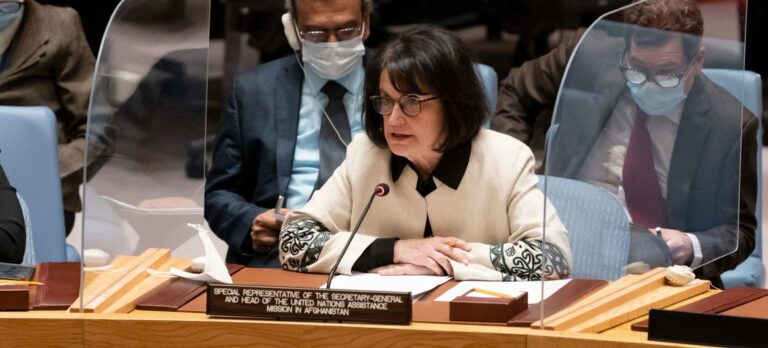
    Deborah Lyons, who also heads the UN Assistance Mission in Afghanistan, lobbied for deepening engagement with the war-torn country’s new authorities and action to prevent an irreversible economic collapse.

    In her briefing to the UN security council in New York on Wednesday, Deborah Lyons, the UN secretary general’s special representative for Afghanistan spoke for engagement with the Taliban.

    Suggesting that the Taliban feels misunderstood, Lyons, a career diplomat from Canada, said that the Taliban cite reduced corruption and the re-opening of schools to girls and boys. “This clash of perspectives forms the basis of a serious distrust that must be addressed,” said the Special Representative.

    According to her briefing, it is now clear that truly assisting the Afghan people will be all but impossible without working with the de facto Taliban authorities.

    Acknowledging the enduring distrust between the Taliban and much of the international community, Lyons said the group feels misunderstood. She said that the Taliban leadership complains that international reports “do not reflect reality as they see it”.

    Civilian casualties in the war-torn country have declined by 78 per cent since the previous government was ousted, the Taliban have claimed, implying that the country is more secure. The Taliban want acknowledgement for this, Lyons said.

    But she also cautioned that more needed to be done and mitigation has to be accompanied with giving hope to the Afghan people by preparing a strong foundation for Afghan self-reliance.

    “It is imperative that we not find ourselves six months from now in the situation we faced six months ago: with millions of Afghans facing another winter of starvation and the only tool at our disposal being expensive and unsustainable humanitarian handouts,” her briefing to the security council reads.

    Dire economy

    In the six months since the Taliban took over Afghanistan, Afghanistan faces an economic collapse.

    “Six months of indecision … are eroding vital social and economic coping systems and pushing the population into greater uncertainty,” she said, adding that, “As the winter season comes to an end, we have perhaps averted our worst fears of famine and widespread starvation.”

    A looming economic tipping point awaits Afghanistan. In such an even, more businesses will close, more people will be unemployed and more families will fall into poverty. Lyons cited a cessation of all development assistance and restrictions on international payments, as well as lack of access to hard currency reserves, lack of liquidity and constraints on the Afghan central bank to carry out some of its core functions.

    Welcoming the unfreezing of some of Afghanistan’s assets by the US treasury facilitating commercial and financial activity and allowing work with all governing institutions, as a “huge step forward”, she said that there were yet other challenges to reviving the economy that has been in freefall mode.
    ”These [challenges] include the collapse of demand due to cessation of all development assistance, restrictions on international payments, lack of access to hard currency reserves, lack of liquidity, and constraints on the central bank to carry out some of its core functions,” she said.
    While UNAMA has taken all conceivable measures to inject liquidity into the economy, including the physical import of cash, she stressed that more international action is needed.
    Lyons has consistently supported the provision of money from the US treasury. Even in her briefing to the security council on 9 September, she had stressed that “a modus vivendi must be found, and quickly, that allows money to flow to Afghanistan to prevent a total breakdown of the economy and social order.”
    Of course, she had also said that, “Safeguards must be created to ensure that this money is spent where it needs to be spent, and not misused by the de facto authorities.”
    Complicated situation

    For its part, she said, UNAMA, continues to report on what it sees on the ground, including concerning restrictions on fundamental rights, extrajudicial killings, enforced disappearances and arbitrary detention.

    Describing the country’s situation as complicated – with both positive and negative trends occurring simultaneously – she said UNAMA can do more by working with the Taliban on the main issues facing Afghan society.
    “You are about to approach a critical moment in your relationship with Afghanistan,” she warned, noting that the security council has the opportunity to build a more solid and relevant UN Mission that will avert the country’s further collapse.


    Image: Mark Garten / UN

    COVID-19 impacts Bangladesh banks’. Bad loans rise by 8 per cent in December

    In what clearly looks like a case of pandemic blues, cases of default on bank loans have been pushed up by 8 per cent in December 2021. This amounts to 1.3 trillion Bangladeshi Takas.

    The COVID-19 pandemic is having an impact on business in Bangladesh. This is evident from the upward trend in the incidence of defaulting on bank loans. Loan defaults have been to the tune of 8 per cent or 1.3 trillion Bangladeshi Takas, in December 2021.

    The country’s central bank, Bangladesh Bank, provided a number of facilities like a loan moratorium and also helped further negotiations on installment payments. But none of that worked. The lending institutions have failed to curb the trend of defaulting loans.

    The defaulting loans, amounting to 1.3 trillion Bangladeshi Takas constitute 8 per cent of all bad loans. It was 88,734 Bangladeshi Takas (7.66 per cent) during the same period last year.

    The total debt of the banking sector stood at Tk 13.18 trillion, according to data made available from the central bank.

    The debt balance was Tk 12.45 trillion end-September. Of this, the defaulted loans shot to Tk 1.15 trillion, or about 8.12 per cent of the total debt.

    Past experience suggests that the default rate among the disbursed loans is a little more than 5 per cent – so, but that watermark, the defaults of 8 per cent have been very high in the data made available for December.

    Optimism belied

    Earlier, on 20 February, Fazle Kabir, the governor of Bangladesh Bank had said that the economy faced a challenge following the COVID-19 pandemic, “but with the power of the resilient private sector of Bangladesh, the economy is performing relatively well in recent past.”

    “Our GDP and total size of the economy have increased which is a good sign and reflects that we are on board,” he had said.

    The release of the December data has belied the Bank governor’s optimism.

    Kabir had claimed that the situation was in control because the government declared a stimulus package at the right time and ensured that there would be no liquidity shortages in banks.


    Image: Wikimedia, Bangladesh Bank, By A Saber91

    A million species endangered risk the web of life 

    Illegal wildlife trade continues to pose a real danger to biodiversity, ecosystems and human health, as a number of emerging diseases stem from animal products, both domestic and wild.

    By Baher Kamal / Inter Press Service

    A million wild plant and animal species are now facing extinction. Three-quarters of the land-based environment, 85 per cent of wetlands, and two-thirds of oceans have been significantly and negatively altered by human activity.

    This warning comes from the United Nations, which revealed these facts in a curtain-raiser to the World Wildlife Day, marked 3 March. These are not by any means just mere figures – it points to risk of extinction of the whole life cycle. 

    Moreover, the world body reports that over 8.400 species of wild fauna and flora are “critically endangered,” while close to 30.000 more are understood to be “endangered or vulnerable.”

    Wildlife, in peril everywhere

    “Today, all around the world, wildlife is in peril. A quarter of species face the threat of extinction, in large part because we have destroyed nearly half of the ecosystems in which they live,” said the UN Secretary-General, António Guterres.

    Wildlife needs to be cared for, the UN boss said. “Beyond a moral duty to sustain the earth, humanity depends on the essential products and services that nature provides, from food and fresh water to pollution control and carbon storage,” Guterres said. “By damaging the natural world, we threaten our own well-being.”

    Incalculable value

    Animals and plants that live in the wild have an intrinsic value and contribute to the ecological, genetic, social, economic, scientific, educational, cultural, recreational and aesthetic aspects of human well-being and to sustainable development, the UN statement underlined.

    “The world is dealing with unprecedented threats to wildlife. Illegal wildlife trade continues to pose a real danger to biodiversity, ecosystems and human health, as a number of emerging diseases stem from animal products, both domestic and wild.”

    Humanity as a whole, threatened

    For its part, the International Union for Conservation of Nature (IUCN) said that continued loss of species and degradation of habitats and ecosystems threatens humanity as a whole, as people everywhere rely on wildlife and biodiversity-based resources to meet all their needs, from food, medicines and health to fuel, housing, and clothing.

    Ivonne Higuero, the secretary general of the Convention on International Trade in Endangered Species of Wild Fauna and Flora (CITES) had  said last November that “Biodiversity loss is an existential threat to people and the planet. The continued loss of wildlife species threatens to undermine entire ecosystems and puts into peril the well-being of all who rely on them…”

    There is no dearth of research and evidence pointing to the growing intensive and extensive human activities being among the main causes behind the loss of wildlife.

    On this, says the UN that “climate change, man-made changes to nature as well as crimes that disrupt biodiversity, such as deforestation, land-use change, intensified agriculture and livestock production or the growing illegal wildlife trade, can increase contact and the transmission of infectious diseases from animals to humans (zoonotic diseases) like COVID-19.”

    Concurrently, Marie Bout, a Global Communications Strategist with Greenpeace International’s political unit had said on this day in 2021 that just 15 per cent of the world’s forests remain intact, and only 3 per cent of the world’s oceans are free from human pressures.

    “The Planet is losing species – its biodiversity – at an alarming rate, thought to be comparable only to the fifth mass extinction 65 million years ago.”

    Why is biodiversity important?

    Biodiversity is built from three intertwining threads, Marie Bout explained: ecosystem diversity, species diversity, and genetic diversity. “Put simply, the more diverse these interwoven natural systems are, the more resilient they are to disturbances.”

    But the disappearance of a specie is like a thread in the web that is cut, leaving holes in the planet’s safety net and shifting the finely balanced systems, she warns.

    “That’s exactly what’s happening on Australia’s Great Barrier reef, one of the world’s most diverse reef ecosystems, which has lost more than half of its coral population since 1995 due to mass coral bleaching events and is dying before our eyes.”

    Supporting life on earth

    According to the Greenpeace activist, nature gives us what we need – food, clean air, and water are the foundations of life. Earth’s biodiversity has provided civilisations with the essentials we need to survive on this planet.

    Nature protects us, she says. Some of the most important roles of biodiversity are defensive. Our ecosystems help to regulate our climate and insure against disease outbreaks like Covid-19. Forests are important carbon sinks and essential for fighting the climate crisis, but oceans also play an important role.

    Nature also keeps things flowing – for example, nitrogen and phosphorus, two primary biological nutrients required by all life on earth circulate through Earth’s ecosystems. But human activity has so thoroughly disrupted Earth’s natural nutrient cycles that we have degraded soils and created aquatic dead zones.

    Lastly, according to Bout, nature even has the potential to solve future problems. Scientific knowledge continues to grow and evolve. The more that we can keep alive and thriving, the greater that knowledge can be. For example, nature has helped, and continues to help in important medical advances.

    What is destroying biodiversity?

    Greenpeace’s Marie Bout further says that as societies (and economies) have grown, so has their ecological footprint.

    “Destructive industries are piling more pressure on our planet’s web of life than at any other point in human history,” she says. “Mega corporations are burning polluting fossil fuels, are setting forests on fire to clear land to grow agricultural commodities and for single use products, and are plundering ever deeper and more remote areas of the oceans, they’re also polluting politics and holding our governments hostage in the process.”

    “Endless pursuit of limitless growth, on a planet with finite resources, has a predictable end that’s already in sight. So much of the wildlife on this planet, including humanity most likely, is heading for extinction.”


    Image: Hippopx, licensed to use Creative Commons Zero – CC0

    Study points to doubled carbon losses from deforestation in tropics in early 2000s

    According to a newly published study in the journal, Nature Sustainability, the acceleration of forest carbon loss highlights the urgent need to halt tropical deforestation to meet global climate change commitments.

    By Aditi Angelina Patro

    A new study reveals that global tropical deforestation has led to a doubling of carbon loss in the early twenty-first century.

    Tropical forests are large carbon stores. When cleared, these forests release these vast amounts of carbon dioxide into the atmosphere. This makes protecting forests critical in the fight against climate change.

    The acceleration of forest carbon losses from the tropical forests highlights the urgent need to halt tropical deforestation to meet global climate change commitments.

    The study, published in Nature Sustainability, is led by Southern University of Science and Technology in Shenzhen, China, and co-authored by scientists at the Wildlife Conservation Society along with more than a dozen other organizations. The results reveal that tropical forest loss between 2001 and 2019 has led to more than a doubling of carbon loss, from 3.5 billion tons of CO2 per year in 2001–2005 to 7.3 billion tons of CO2 per year in 2015–2019.

    The carbon losses were calculated from high-resolution satellite datasets. The doubling of gross tropical forest carbon loss worldwide from forest conversion is “higher than in bookkeeping models forced by land-use statistical data,” the scientists have said.

    Forest land to agriculture

    To arrive at a correct calculation, the authors paired high-resolution satellite measurements of forest loss with carbon density maps from three sources (aboveground biomass, belowground biomass, and soil) to create detailed maps of where, when, and how much carbon was impacted by forest loss during each year between 2001-2019.

    Said Paul Elsen, climate adaptation scientist at the US-based Wildlife Conservation Society and a co-author of the study: “This new approach reveals carbon losses from tropical deforestation that were overlooked in previous assessments. This provides a more accurate accounting of carbon emissions from forest clearing.”

    The authors note that most of the forest that was cleared between 2001-2019 remained cleared into 2020. Only about 30 percent of the forests that were cleared during that period began to regenerate to either forest or shrubland by 2020.

    “We find that about 70 per cent of former forest lands converted to agriculture in 2001–2019 remained so in 2020, confirming a dominant role of agriculture in long-term pan-tropical carbon reductions on formerly forested landscapes,” the scientists say in the study published Wednesday.

    Glasgow commitments

    The results of the study are counter to those of previous assessments, such as the Global Carbon Budget 2021, which showed a slightly negative trend in tropical carbon loss from deforestation in recent years. The authors note that this is largely due to much more accurate accounting of carbon losses through the use of high-resolution, spatially explicit maps of carbon and forest loss, rather than simply calculating losses from government data.

    The study was released on the same day as the release of the latest IPCC report, which highlighted the overwhelming vulnerability of socioeconomic and natural systems to climate change if left unabated. Late last year, nearly 150 countries convened at COP26 in Glasgow to formally commit to halting and reversing deforestation by 2030.

    This acceleration and high rate of forest carbon loss suggests that existing strategies to reduce forest loss have not been successful, underscoring the importance of monitoring deforestation trends following the new pledges made in Glasgow.

    “The accelerating trend of forest carbon loss we observe underscores that we need to do much more to meet our international commitments on climate change,” said Elsen. “Continued forest and carbon losses of the magnitude that we’ve seen over the past five years could push limiting climate change to between 1.5-2°C out of reach, which we now know would have huge consequences for both people and nature.”


    Image: Hippopx – Licensed to use under Creative Commons Zero – CC0